What to Look for in an Automated Crypto Trading Bot (And How Visual Builders Handle Stop-Loss and Averaging)
An automated crypto trading bot is only as trustworthy as the logic you can actually see in it. Before you risk real funds, look at its entry, averaging, and stop-loss rules the way you'd look at a contract — laid out, readable, and adjustable — rather than trusting a downloaded script or a bold AI claim to do the right thing on faith. That's the real difference between a bot worth using and one worth skipping, and it's what the rest of this guide walks through: what these bots actually do, what separates a transparent one from a black box, and what to compare before you connect any of them to your exchange account.
What an Automated Crypto Trading Bot Actually Does
An automated trading bot is software that watches a market and places orders for you according to rules you've set, instead of you clicking buy and sell by hand. In crypto, that means connecting to your account on a crypto exchange — the platform where the coins actually trade — and executing orders there once its conditions are met. Sophistication varies widely: some "bots" are little more than a single alert, while others are full multi-stage systems that open a position, add to it, take profit, and cut losses.
Why black-box "free EA" downloads and hyped AI bots are hard to trust
A lot of what gets marketed as an automated trading bot is a file you install and trust blindly, or a bold claim about an AI engine reading the market for you. The Expert Advisor, or EA, format is a good example: on platforms like MetaTrader, some EAs are full strategies and others are just trade-management utilities, and you often can't tell which until you've already added one to your account. AI-branded bots raise a different problem — a language model can technically be wired into live market feeds and order execution, but being plugged into trading infrastructure says nothing about whether its decisions are sound or explainable afterward. Neither format lets you inspect the rule set before you commit capital: you're trusting the label, not the logic.
How a visual deal map shows entry, averaging, and exit together
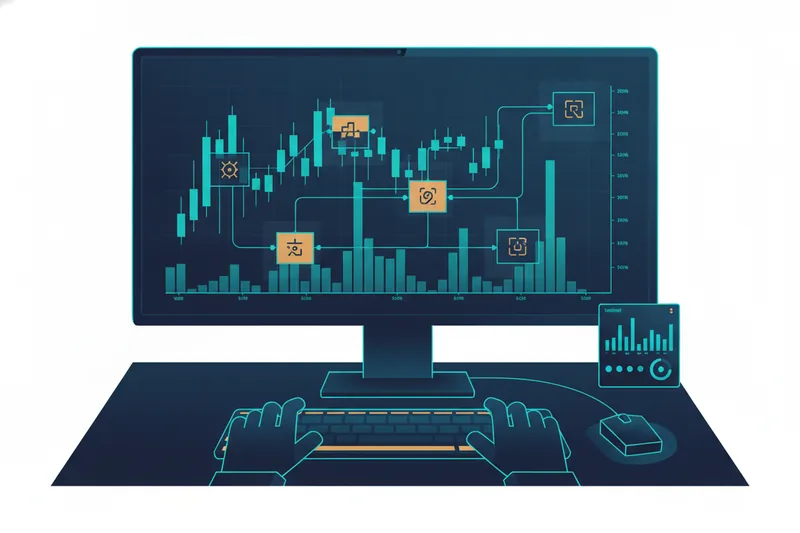
A no-code trading bot built around a visual strategy builder handles this differently. Instead of code or a marketing claim, you get a diagram — often called a deal map — laying out each stage of the trade: the entry condition that opens the position, any averaging orders (DCA, or dollar-cost averaging — additional buy orders placed as price moves against you, to lower your average entry price), the exit that takes profit, and the stop loss order that closes the position at a defined loss if the trade goes wrong. Quberas builds its bots this way, as a map of connected stages you can inspect before anything goes live. Visual, no-code builders aren't unique to crypto — platforms like Tradetron apply the same drag-and-drop logic more broadly — but the principle holds everywhere: if you can see the rule, you can judge and adjust it. If you can't, you're back to a black box with a friendlier interface.
The Principles That Decide Whether a Bot Is Trustworthy
Two things decide whether an automated trading bot deserves real money: whether its entry conditions are genuinely transparent, and whether you tested it against history before trusting it with the present.
Why you should see a condition that "almost triggered," not just ones that fired
An entry condition is the rule that has to be true for the bot to open a trade — price crossing a moving average, an indicator hitting a threshold, and so on. Knowing a trade triggered only tells you the rule fired once; it doesn't tell you how close it came to firing on noise rather than signal. A bot that only shows triggered conditions hides the difference between a well-tuned strategy and one that's one tick from firing on every minor wobble. Seeing how near a condition came to triggering, not just whether it did, is what lets you tell those two situations apart.
What backtesting can and can't tell you before going live
Backtesting runs your rules against historical price data to see how a strategy would have performed in the past. It's the best sanity check available before risking capital, but it has limits: history doesn't repeat exactly, how much of it you can test against depends on the platform and plan, and the conditions in your test window may not resemble the ones you'll trade in next. Treat a good backtest as evidence the logic isn't broken, not as a forecast.
Risk management doesn't stop once a strategy backtests well and goes live. Even a fully automated bot still needs a person checking in on it and an independent way to cancel orders if something goes wrong — the exchange connection, the hosting, or the strategy itself can all fail in ways no backtest predicted.
Tuning Entry Conditions to Reduce False Signals
Most false signals trace back to one thing: a threshold set too close to normal market noise. If your entry condition is "RSI below 30" and price oscillates between 29 and 31 all afternoon, you'll get entries that technically satisfied the rule but had no real edge behind them.
Reducing that noise means looking at the trades your bot skipped, not just the ones it took. If you can see how close a condition came to triggering on trades it didn't take, you can tell whether a threshold is well-calibrated or just lucky. A threshold that fires five times a day on sideways price action is a different strategy from one that fires twice a week, even if the rule looks identical on paper.
This also matters in multi-stage strategies, where one condition's trigger depends on another having fired first — an averaging order only matters once the entry has already opened the position, so tightening one threshold often means re-checking the ones downstream of it. In practice it's an iterative loop: adjust a threshold, backtest again, check whether the near-misses it now excludes were ones you actually wanted to catch, and repeat. A bot that lets you see and move that threshold directly, rather than re-coding and redeploying a script, is what makes that loop fast enough to run more than once.
The Realistic Risks of Automated Trading
Automation changes how a strategy is executed, not whether the market can move against it. Crypto prices are volatile, and a bot following its rules perfectly can still lose money if the market does something those rules didn't anticipate — a sharp liquidity drop, for instance, or a trend that doesn't resemble the one the strategy was built around. No automated trading bot, however well designed, guarantees a return.
Risk limits aren't automatic just because the bot is. Professional trading programs build in strict rules for this exact reason: some prop trading firms fail an account the moment a maximum loss limit is touched, even on paper losses that haven't been realized yet. The same discipline applies at a smaller scale to anyone running a bot — a stop loss order only protects you if it's set at a level you've actually thought through, and a strategy with no loss limit at all is one that can keep digging.
There's also an operational risk: the bot only does what your exchange connection and account allow. How you scope your API key — the credential that lets a platform place orders on your exchange account on your behalf — is itself a risk control. None of this is a reason to avoid automation; it's a reason to treat a live bot the way you'd treat any system handling your money: something to monitor, not something to walk away from.
Comparing Automated Trading Bot Options Before You Commit
Automated trading bots fall into a few broad categories, and knowing which one you're looking at matters more than any single feature.
Visual, no-code builders let you assemble a strategy from blocks or a flowchart instead of writing a script. Deriv Bot Builder is a well-known example, built as a visual platform for creating and automating strategies without code — but for Deriv's own forex and synthetic markets, not crypto exchanges, which is worth knowing before assuming any visual builder connects to your exchange account.
Free, downloadable EA files are a second category — strategies packaged as a file you install, advertised with language like the Scalper AvtomatFX EA's claim to be an optimized robot free for download. The problem isn't that it's free; it's that you're trusting a compiled file instead of a rule set you can read.
A third category leans on AI branding rather than visible logic. Pocket Option, for instance, markets itself around unlocking trading success with AI trading bots, without showing what decisions the bot makes or why. "AI" describes a technique, not a guarantee it works, and it tells you nothing about the rules underneath.
Questions to ask before trusting any bot with real funds
- Can you see every entry, averaging, and exit condition before the bot goes live, in plain terms rather than a script?
- Does it connect to your crypto exchange through your own API key, with permissions you can scope yourself?
- Can you backtest the specific strategy you're about to run, and does the platform tell you how much history that test covers?
- Does it fit the approach you're actually running — scalping, trend-following, range, or breakout entries — rather than forcing one style on every strategy?
- Once it's live, is there a clear way to monitor it and cancel orders independently of the bot itself?
A sound habit, whatever platform you land on, is backtesting against historical data first and then forward-testing on live or paper data before real capital goes in. Skipping straight from an idea to live funds is where most avoidable losses start.
Common Questions About Automated Crypto Trading Bots
Is there an automated trading bot built specifically for crypto, not stocks or forex? Yes — many platforms are built around crypto exchange connections rather than brokers. A bot that talks about brokers, CFDs, or futures contracts isn't one of them.
What's the real difference between a free and a paid no-code bot platform? Usually how much you can do before paying: how much history you can backtest, how many strategies you can run, and whether orders are live or restricted to a testnet — a simulated market environment with no live orders. Check exactly what "free" includes before assuming it trades with real funds.
How do averaging orders (DCA) actually work in a bot? Not all DCA bots work the same way. Some place a fixed buy on a schedule regardless of price; others add further buy orders as price falls, to bring down the average entry price — that second kind is what most people mean by an averaging strategy.
Are all crypto bots the same type of tool? No. Beyond DCA and grid bots, some platforms also offer signal bots, which trade off external alerts rather than their own built-in logic. A signal bot's trustworthiness depends partly on the signal source, not just the execution.
Do I need to leave my computer running for the bot to work? A bot generally needs to run continuously to catch conditions as they occur, whether on your own machine or hosted elsewhere. A home PC can run it around the clock, but a dedicated server reduces downtime from your own power, internet, or hardware failing.
If you want to see how your own entry, averaging, and stop-loss rules would actually look and behave before risking anything, Quberas lets you build that logic as a visual deal map and run it on a free testnet account — no live orders, no code — so you can judge the rules yourself before deciding whether to fund it.
This article is general information about how automated trading tools work, not personal financial or investment advice. Crypto markets are volatile, an automated strategy can lose money as easily as it can make it, and nothing here guarantees future returns — treat any bot, backtest, or track record as one input into your own decision, never a substitute for it.