Algorithmic Trading Explained: Basics & Strategies
Algorithmic trading is the use of predefined, rule-based logic — rather than in-the-moment judgment — to decide when to enter a trade, when to exit it, and how much risk to take on. At its core, the basics of algorithmic trading come down to turning that logic into conditions a system can evaluate and act on without a person clicking anything. A trading algorithm is that rule set, expressed as conditions a system can evaluate and act on without a person clicking anything. What follows walks through how those rules turn into live trades, and what the main families of algorithmic strategy actually look like once they do.
What Algorithmic Trading Actually Means
The rules behind a trading algorithm are concrete, testable conditions: price crosses above a moving average, volatility drops below a threshold, a stop-loss level is hit. None of that requires writing software — visual, drag-and-drop builders let traders assemble the same conditional logic without programming, and tools once reserved for hedge funds and institutional desks are increasingly available to individual retail traders. No-code tools make this approach accessible to traders who build these rule sets visually rather than in code, and the pattern holds regardless of the tool: a strategy is only as reliable as the logic behind it, and that logic is only trustworthy once it has been precisely defined and tested.
From a Trading Rule to an Automated Order
An algorithmic strategy moves through three stages before it ever touches real money: the rules are defined, the rules are tested against history, and only then are they handed to a system that can act on them unattended.
Defining entry and exit rules
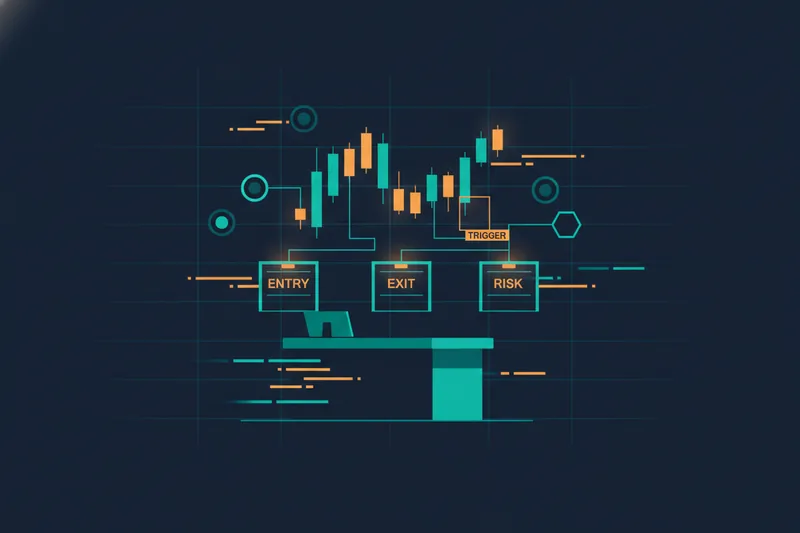
Entry rules state the exact condition that opens a position — a moving-average crossover, an oversold indicator reading, a break above a recent high. Exit rules do the same for closing it: a profit target, a trailing stop, a time-based cutoff. Technical indicators — moving averages, RSI, Bollinger Bands, volume measures, and others — supply the inputs these rules are built from. Risk management sits alongside them: how much capital goes into one trade, how much total exposure is allowed across all open positions, and what reward is required before the risk is worth taking. Many traders build in a hard ceiling on risk per trade and total open exposure, along with a minimum profit-to-loss ratio a trade must meet before it qualifies. The exact numbers vary by trader, but the shape — a hard ceiling on loss, a floor on reward — is what lets an algorithm act consistently instead of case by case.
Testing the logic before it runs
Before a rule set gets near live capital, it is run against historical price data to see how it would have performed. This is backtesting. It doesn't predict the future, but it shows whether the logic behaves as expected: whether the entry fires too often, whether the stop gets hit before a move develops, whether the strategy would have survived a sharp reversal.
Letting the system execute
Once the rules hold up, order execution automation takes over: the system watches live prices and submits an order the moment a condition is met, with no one waiting to click a button. Underneath, this usually comes down to a small set of order types — market orders that fill immediately at the current price, limit orders that only fill at a specified price or better, and stop-loss orders that convert into a market order once a trigger price is reached. Some systems generate every signal from their own internal rules; others are built to execute an order the moment an external signal or alert arrives.
What the Main Strategy Types Look Like in Practice
Each strategy type below is a different answer to the same question: what market condition is the algorithm trying to exploit?
Trend-following
A trend-following strategy assumes a price already moving in one direction is more likely to continue than reverse, at least for a while. A simple version enters long when a shorter moving average crosses above a longer one and exits when it crosses back below. The indicators behind this kind of rule usually come from the trend family, though a complete strategy often layers in momentum or volatility indicators to filter out weak signals.
Mean-reversion
A mean-reversion strategy assumes the opposite: that a price swinging away from its average eventually snaps back. A common version buys when an asset is unusually oversold relative to a short-term average — an RSI well below 30, say — and sells once it recovers toward that average. It tends to work best in a range-bound market, and tends to lose precisely when a trend-following system would be making money.
Statistical arbitrage
Statistical arbitrage looks for a relationship between two or more instruments — two historically correlated stocks, for instance — and trades the gap when it widens beyond its normal range, betting the relationship holds and the prices converge again. In principle it's market-neutral: the position profits from the relationship closing, not from either asset rising or falling on its own.
High-frequency trading
High-frequency trading applies the same rule-based logic at a far smaller timescale — positions held for seconds or fractions of a second, decisions driven by order-book data rather than daily charts. It depends on execution speed and infrastructure well beyond a typical retail setup, which is why it stays concentrated among specialized trading firms rather than something an individual replicates directly.
Algorithmic Trading vs. Discretionary Trading and Simple Automation
Discretionary trading is the mirror image of algorithmic trading: a trader reads the chart, the news, and their own experience in the moment and decides what to do, and two traders looking at the same setup can reasonably act differently. An algorithmic strategy removes that variability by design — given the same inputs, it makes the same decision every time, because the decision was fixed in advance rather than made live.
It's also worth separating algorithmic trading from simple automation, which often gets lumped in with it. A bot that buys a fixed amount of an asset on a schedule, for example, is automated — it runs without a human pressing a button — but it isn't reacting to market conditions; it executes on a timer regardless of price. A rule-based algorithmic strategy is conditional instead: it only acts when its defined criteria are actually met. The same distinction shows up across trading tools generally — not everything labeled automated is placing trades. Some tools exist purely to annotate a chart or flag a setup, while a separate piece of logic handles execution. Automated just means a human isn't clicking the button; it doesn't by itself mean something is evaluating market conditions and making a trading decision.
Where Algorithmic Trading Helps — and Where It Stops Being Useful
The appeal of algorithmic trading over manual trading is consistency: the same rules apply every time, without fatigue, hesitation, or an emotional reaction to a losing streak. It can act faster than a person watching a chart, and because the logic is explicit, it can be tested against years of data before a single dollar is at risk — something a purely discretionary approach can't really offer.
The risks sit on the other side of the same coin. A rule set that performed well on historical data can still fail once conditions change — a trend-following system built during a rising market has no guarantee it handles a sideways or falling one the same way. Over-fitting is a related trap: a strategy tuned so precisely to past data that it captures noise rather than a real pattern will often disappoint going forward. And automation doesn't remove operational risk — a bad connection, a mistimed parameter change, or an unexpected market gap still needs a human watching for it.
This is also why a backtest is never treated as the finish line. Most practitioners run a strategy through forward testing — watching it trade on live or simulated data — before committing real capital, treating the two stages as equally necessary rather than one substituting for the other. Algorithmic trading replaces guesswork with a defined process; it doesn't replace the need to check whether that process still fits the market it's running in.
Common Questions Beginners Ask About Algo Trading
Do you need to code to trade algorithmically? No. Visual, no-code builders let traders define the same conditional rules — entry, exit, risk limits — without writing software, though the thinking behind the rules is identical either way.
How much capital do you need to start? There's no fixed minimum. It depends on the instrument, the position-sizing rules the strategy uses, and the risk limits a trader sets. A strategy built around tight risk-per-trade limits can be tested and run on a smaller account than one that relies on wide stops.
Is algorithmic trading only for institutions? No. Tools once mostly available to hedge funds and professional desks are now accessible to individual retail traders, though high-frequency trading specifically still depends on infrastructure most individuals don't have.