What Is Day Trading? A Beginner's Guide
Day trading is the practice of buying and selling the same financial instrument within a single trading session, closing every position before the market closes, with the goal of profiting from short-term price moves rather than a company's long-term growth. Nothing carries over to the next day. For anyone looking for a day trading for dummies explanation, that single fact — same-day open, same-day close — is what separates day trading from every other way of putting money into markets, and it's the thing to understand before anything else makes sense.
What Day Trading Actually Means
A day trade is a position opened and closed on the same calendar day, in the same market session. The trader isn't betting on where a stock, currency pair, or crypto asset will be in a year — they're betting on where it will be in the next few minutes or hours. Profit comes from catching a price swing while it's happening: buy low and sell higher (or sell short and buy back lower) before the closing bell, so no overnight risk is carried.
This matters because day trading is a style of trading, not a strategy in itself. Two day traders can use completely different methods — one reading chart patterns, another reacting to news — and both are still "day trading" as long as they open and close within the day. The label describes the time horizon, not the technique.
How a Day Trade Unfolds
Every day trade has the same basic shape, regardless of the market or the method behind it.
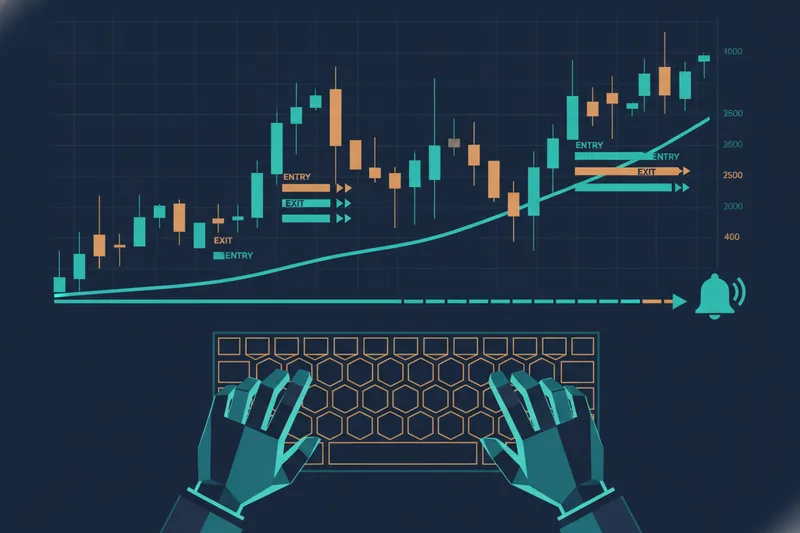
First comes the entry: the trader decides a price is about to move and buys (or sells short) at that moment. Then comes monitoring: the position is watched while it's open, often for minutes rather than hours. Finally comes the exit: the trader closes the position, either because it hit a profit target, hit a stop level, or because the session is ending and nothing in day trading is meant to stay open overnight.
Core vocabulary a beginner needs
A stop-loss order is an instruction placed in advance that automatically closes a position if the price moves a set distance against the trader. It exists because day trades move fast, and waiting to decide "in the moment" whether to cut a loss is how small losses become large ones.
Margin trading means borrowing capital from a broker to control a larger position than the trader's own cash would allow. It magnifies both the gain and the loss on a trade, which is part of why day trading accounts are treated differently by regulators than ordinary cash accounts.
Volatility describes how fast and how far a price swings in a given period. Day trading depends on volatility existing — an asset that barely moves in a session gives a day trader nothing to capture — but higher volatility also means stop-losses get hit more often and by larger amounts.
Chart patterns are recurring visual shapes that show up in price history — a narrowing range before a breakout, a repeated failure to clear a certain level — that some traders use to anticipate the next move. They're a tool within technical analysis, the broader practice of studying price and volume history instead of a company's underlying business, to decide when to enter or exit.
A Concrete Example: Watching One Day Trade Play Out
Say a trader is watching a stock that opens the session at $50.00 and climbs steadily in the first twenty minutes to $50.40 on noticeably higher-than-usual volume — a sign of volatility and interest converging. The trader decides this looks like the start of a short-term move and buys at $50.45.
Immediately, they place a stop-loss at $50.10, accepting a maximum loss of $0.35 per share if the move reverses. They also set a mental or automated exit around $51.20, based on a prior price level where the stock struggled earlier in the week — a chart pattern they're watching for.
Over the next hour the stock drifts up to $51.15, stalls, and starts to pull back. The trader exits manually at $51.05 rather than waiting for the stop, locking in $0.60 per share. Whether that decision to exit early was the right one only becomes clear in hindsight — which is exactly the kind of judgment call day trading is full of. By the market close, the position is gone either way: profit taken, loss capped, or stopped out automatically. Nothing is held overnight, and tomorrow starts from zero.
Day Trading vs. Swing Trading, Scalping, and Investing
These four terms get used almost interchangeably by beginners, but they describe different holding periods and different relationships with risk.
Day trading closes everything within the session. Swing trading holds a position for several days to a few weeks, aiming to capture a larger price swing than a single session usually offers, and accepting overnight and weekend risk in exchange. Scalping is a more extreme version of day trading: trades are often held for seconds to a few minutes, on very short timeframes — commonly one-minute to fifteen-minute charts — where the outcome depends heavily on execution speed and spread rather than any big market move. Long-term investing abandons the short-term lens entirely, holding assets for years based on the underlying business or asset's value, largely ignoring the daily noise that day traders are trying to profit from.
The practical difference for a beginner is exposure time. A day trader is exposed to a position for hours at most; an investor is exposed for years. That difference changes everything about what matters — day traders care about intraday volatility and execution, investors care about fundamentals and patience.
Where Day Trading Stops Making Sense
Realistic odds of success
Day trading demands things beyond knowing the vocabulary. Capital is the first constraint: a trader working with only a few hundred dollars loses a much larger share of each gain to commissions, spreads, and slippage than someone trading a larger account, and a thin account has little room to survive a run of stopped-out trades. That's part of why many beginners start with amounts too small to absorb normal losing streaks, let alone the costs of frequent trading. In the US, the pattern day trader rule long required at least $25,000 in a margin account used for four or more day trades within five business days; FINRA's new rules replace it with intraday margin requirements from June 4, 2026, but brokers have until October 20, 2027 to switch, so check your broker's current requirement before trading often in a margin account.
Time is the second constraint. The US stock market's regular session runs from 9:30 a.m. to 4 p.m. Eastern, and day trading generally means being present for some or all of that window rather than checking in once during a lunch break, because the volatility-driven setups it relies on can form and disappear within minutes.
Then there's the psychological toll: making fast decisions with real money, repeatedly, and taking a loss exactly where the plan said to without second-guessing it mid-session — a kind of sustained pressure that people who've only read about day trading, not done it, consistently underestimate.
Is day trading profitable for the average beginner? The honest answer, consistent across most accounts of retail trading outcomes, is that a clear majority of people who try it lose money, especially early on, and only a small share sustain profits once costs are factored in. The reason usually isn't a missing technique — a plan that looks sound on paper still has to survive contact with real, fast-moving prices and a trader's own impulses under pressure. That gap between a plan that should work and one that has actually been tested against real conditions is the real substance behind any day trading for dummies explanation, and it matters more than chasing a particular technique before trying day trading at all.