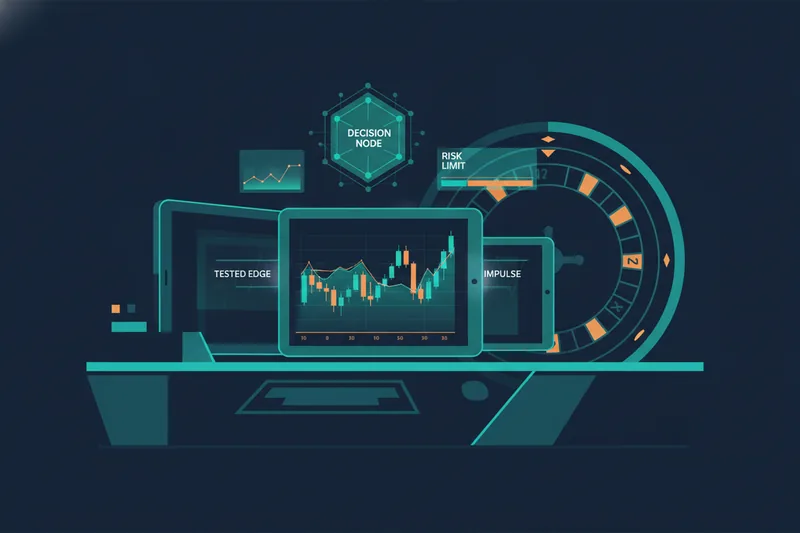
Is Day Trading Gambling? Tested Edge vs. Impulse
The question "is day trading gambling" doesn't have a simple yes-or-no answer: day trading is not gambling in a strict definitional sense, but a given trade can be functionally identical to a bet if the decision behind it works the same way a slot machine pull does. The line between the two isn't the market, the asset, or even the frequency of trades — it's whether the entry comes from a rule that has been tested against data and paired with defined risk limits, or from an impulse chasing excitement or a feared loss. Day trading and gambling overlap heavily in how they feel in the moment; they diverge sharply in how the decision was made before that moment arrived.
Day Trading vs. Gambling: Where They Overlap and Where They Don't
Day trading means buying and selling a financial instrument — stocks, futures, forex pairs, crypto — and closing the position before the session ends, aiming to profit from short-term price movement rather than long-term appreciation. It covers a range of distinct approaches: scalping, which works on charts as short as one to fifteen minutes and holds positions for seconds or minutes, alongside range trading, trend trading, gap trading, and breakout trading, each reacting to a different kind of price pattern within the same session.
Gambling means placing something of value at risk on an outcome that is substantially determined by chance, for a potential payout. A hand of blackjack, a sports bet, a slot machine spin — the result is largely outside the bettor's control once the wager is placed.
The overlap is real: both involve risking capital on a near-term, uncertain outcome, both ask for repeated decisions under time pressure, and both can produce the same rush of anticipation while a position or a hand is still open. That overlap is exactly why "is day trading gambling" doesn't have a glib one-line answer — the two activities can look procedurally identical from the outside. The difference isn't in what it feels like to click buy. It's in whether the uncertainty was measured and bounded beforehand, or simply absorbed in the moment, trade by trade.
Why Trading and Gambling Can Feel Identical to the Brain
The reason the two are so easy to confuse isn't coincidence — it's neurochemistry. Dopamine, the brain's reward-anticipation chemical, fires not mainly when you win, but when you're waiting to find out if you will. A trade sitting open in the money does the same thing to the reward pathway as a slot reel still spinning: the uncertainty itself generates the charge, more than the eventual outcome does.
That effect is amplified by variable reinforcement — a reward schedule where wins arrive unpredictably, in unpredictable sizes, rather than on a fixed, known schedule. Unpredictable rewards are consistently more compelling to the brain than predictable ones; it's the same mechanism that makes a slot machine more engaging than a vending machine that always pays out on the third pull. Trading delivers variable reinforcement by nature: position sizes, win rates, and payoffs differ trade to trade, with no way to know in advance which one will pay off.
Put the two together and you get the conditions for compulsive, excitement-seeking behavior regardless of what the activity is officially called. A trader who enters a position because the price is moving fast and they don't want to miss it — fear of missing out, acted on instantly — is responding to the same dopamine-and-uncertainty loop as someone pulling a lever, even if the account is labeled a brokerage account rather than a casino chip tray. The feeling of needing to act right now is not a reliable signal that the decision is sound. It's often a reliable signal that the reward pathway, not a tested rule, is making the call.
Warning Signs Your Trading Has Slipped Into Gambling
A handful of behaviors mark the point where trading activity has stopped running on a plan and started running on impulse.
- Chasing losses: increasing position size after a loss specifically to win it back quickly, rather than because the new trade meets the same criteria as any other. The decision is driven by the previous outcome, not by current market conditions.
- Trading without a plan: entering positions based on a headline, a chart that feels like it's about to move, or a tip, with no entry, exit, or invalidation point decided in advance.
- Oversized position sizing: risking a share of the account on a single trade that's disproportionate to overall risk tolerance, usually because that particular trade feels unusually certain in the moment.
- Ignoring stop-loss rules: moving a stop further away once price approaches it, or removing it altogether, on the belief that it'll come back — turning a defined, pre-accepted loss into an open-ended one.
None of these behaviors require a casino or a betting slip to qualify as gambling in substance. What they share is a decision rule that gets rewritten after the fact, in response to emotion, rather than one set before the trade and followed regardless of how the trade feels while it's open. A trader who does one of these occasionally isn't necessarily gambling; a pattern that relies on them routinely effectively is, whatever instrument is being traded.
What Actually Separates a Trading Edge From a Bet
A statistical edge is a measurable advantage — a rule or set of rules that has produced a favorable outcome across many instances, not a single convincing one. The defining feature of an edge is that it was identified by looking backward across a large enough sample to separate a real pattern from noise, before any capital was risked on it live.
That identification happens through testing. Backtesting runs the rule against historical data to see how it would have performed; forward testing then runs it on live, small-scale conditions to confirm the backtest wasn't an artifact of the specific historical period used. Neither stage substitutes for the other — a strategy is generally expected to pass both before it's trusted with meaningful capital. Performance from that testing is usually judged with a risk-adjusted measure like the Sharpe ratio, where a reading above 1.0 is considered acceptable, above 2.0 is strong, and above 3.0 is excellent — a way of asking not just whether a strategy made money, but how much risk it took to make it. These thresholds are a loose convention rather than a universal standard, and what counts as a strong Sharpe ratio can vary by strategy type and market.
Risk management is the second pillar: explicit limits on how much can be lost on one trade and on the account as a whole, decided before any position is opened. Traders commonly cap risk using small, fixed percentages of capital — both per trade and across all open positions at once — decided in advance rather than adjusted in the moment. The specific numbers vary by trader and strategy, but the structure — a cap decided before the trade, not during it — is the point.
A trading plan ties both together: a written set of rules for entries, exits, sizing, and risk that gets followed on a losing day exactly as it does on a winning one. That's the structural difference from a bet — not the instrument, not the holding period, but whether the decision existed, tested, before the trade was placed.
What the 97% Loss Statistic Really Proves (and Doesn't)
Most traders have run into some version of the claim that the overwhelming majority of day traders lose money, often cited in the high-90s as a percentage. Treat the exact figure cautiously — win-rate statistics like this vary by study, market, and time period — but the general finding, that most self-directed day traders underperform or lose money over time, shows up consistently enough to take seriously.
What it doesn't prove is that day trading is inherently gambling. The statistic typically measures outcomes, not methods: it lumps together traders following a tested plan with defined risk limits and traders trading on pure impulse, and reports what happened to the group as a whole. A high failure rate across a mixed population says more about how many people trade without an edge than about whether an edge is possible at all.
Survivorship bias also distorts the picture. Samples drawn from brokerage accounts or trading forums tend to undercount traders who quit early, and overrepresent whichever subset stuck around long enough to be surveyed, which can skew results in either direction depending on who that subset is. None of this means the loss statistic is wrong to cite; it means the honest conclusion is narrower than "day trading is gambling." It's closer to this: most people who day trade do so without the structural factors — a tested edge, backtesting, defined risk limits — that separate systematic trading from a bet, and the statistic reflects that, not some inherent randomness baked into the activity itself.
Where Even Systematic Trading Still Carries Gambling-Like Risk
None of this makes systematic trading risk-free, and claiming otherwise would be its own kind of overconfidence. A backtested edge can decay: market conditions that produced a pattern can change, and a rule tuned to one period can simply stop working in the next without warning. This is model risk, and no amount of historical testing eliminates it, because historical data by definition cannot include what hasn't happened yet.
Related to this is market regime risk — a strategy built and tested during a trending, low-volatility period can behave very differently once volatility spikes or the market shifts from trending to ranging. A tested edge is a statement about the past, not a guarantee about the future; it shifts the odds, it doesn't remove uncertainty from any single trade.
There's also a subtler risk: overconfidence in the system itself. A backtested, rule-based strategy can create a false sense of certainty that leads a trader to oversize a position or ignore a warning sign, reasoning that the system says so. Easier access to sophisticated tools doesn't fix this on its own — algorithmic and AI-assisted tools once reserved for institutional desks are now available to everyday retail traders, but a tested rule followed with oversized risk is still a bet, just a better-documented one. Systematic trading doesn't eliminate gambling-like risk; it narrows and measures it, which is a meaningfully different thing from removing it altogether.