What Is Intraday Trading? Definition & How It Works
Intraday trading is the practice of opening and closing a position in a stock, currency pair, futures contract, or cryptocurrency within a single trading session, so that nothing is held once the session ends. The trade is entered, managed, and closed the same day — there is no overnight position sitting exposed to news that breaks while the market is shut. This article covers how that mechanic actually works, how it's decided when to get in and out, how it compares to day trading and swing trading, and where it stops being a practical way to trade at all.
What Is Intraday Trading?
Because every position is flattened by the close, an intraday trader isn't exposed to the overnight gap in price that can follow news breaking while the market is shut. The trade-off is that the whole approach leans on movement that happens while the market is open, so decisions have to be made, and often unwound, within a few hours rather than days.
What ties individual trades together into something repeatable is a trading strategy: a written set of rules for what triggers an entry, what triggers an exit, and how much is risked on each one. Without that structure, intraday trading is just fast, frequent guessing — which instruments or stocks actually suit this pace is a separate question from the mechanics covered here.
How an Intraday Trading Session Actually Works
Session timing and order flow
A trading session runs from a market's open to its close, and intraday trading lives entirely inside that window. Exact hours depend on the exchange and instrument — equities, futures, forex, and crypto markets all run on different schedules, some close to continuously — but the same principle holds everywhere: a position opened during the session has to be closed before it ends.
Orders are how that happens in practice. A market order executes immediately at the best available price; a limit order waits until the instrument trades at a specific price or better. Intraday traders use both, market orders when speed matters more than price precision, limit orders when the entry or exit level is the point of the trade. The exact sequence of placing one of these orders is its own step-by-step process, separate from understanding what it does.
Leverage and margin basics
Leverage lets a trader control a larger position than their account balance alone would allow, using margin — capital the broker or exchange effectively extends against the position. It cuts both ways: a given move against a leveraged position produces a proportionally larger loss than the same move unleveraged, and a position can be reduced or closed automatically if losses erode the required margin buffer. Exact requirements and maximum leverage differ by broker, instrument, and jurisdiction, which makes this a detail to check before taking a position rather than one to assume.
How entries and exits are typically decided
Most intraday entries and exits are built around technical indicators — calculations applied to price and volume, such as moving averages or momentum oscillators, that turn raw price action into a readable signal — and chart patterns, the recognizable shapes price leaves behind, like a breakout above resistance or a pullback to a prior support level. A strategy typically combines a few of these into entry logic ("buy when X crosses above Y") and separate exit logic for taking profit or cutting a loss.
The timeframe matters as much as the logic itself. Some intraday approaches, like scalping, work on very short charts — from one-minute to fifteen-minute — where a trade lasts seconds to minutes and the result depends more on execution speed and spread than on a sustained price move. Others hold a position for a larger part of the session, reading the same indicators on a slower chart.
A Simple Intraday Setup, Walked Through
A simple illustration, not a recommendation, shows how the pieces fit together. Suppose a trader watches a stock on a five-minute chart and uses a short moving average crossing above a longer one as the entry signal, combined with the price trading above the session's opening level as a filter.
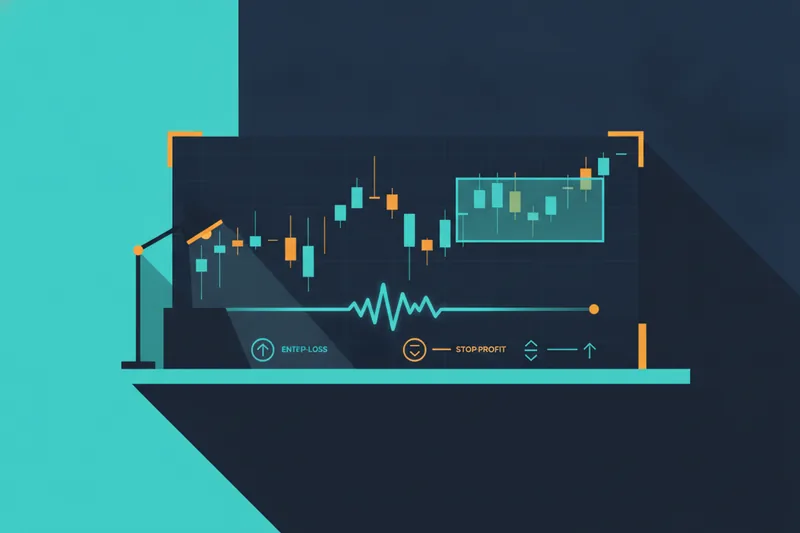
Early in the session, the shorter average crosses above the longer one while price is also above the open — the entry condition is met, and the trader buys. The stop-loss is placed just below the most recent swing low on the chart, defining the maximum loss if the trade goes the wrong way. The take-profit is set at a fixed multiple of that same distance: if the stop is $0.40 below entry, the target might be $0.80 above it, a 2:1 reward-to-risk setup.
From there, the trade manages itself against those two levels. If price reaches the target first, the position closes for a gain; if it reaches the stop first, it closes for the defined, limited loss. Either way, the position is flat well before the session ends.
The specifics here — the indicators, the timeframe, the multiple — are illustrative. What makes the example intraday is not the particular rule set but the structure: a defined entry condition, a defined exit condition on both sides, and a session boundary that forces the position closed regardless of how the trade is going.
Intraday Trading vs Day Trading vs Swing Trading
Day trading and intraday trading are often used as if they mean the same thing, and in casual use they mostly do — both describe trades that open and close within a session. The more precise distinction is that day trading is the broader label for anyone whose activity is defined by that same-session constraint, while the approach underneath it varies widely: scalping, range trading inside a channel, trend trading, trading a gap at the open, and breakout trading are all different day trading styles that share the same session boundary but make entry and exit decisions differently.
Swing trading sits on the other side of that boundary. A swing trade is held for several days to a few weeks, aiming to capture a larger move than a single session usually offers. That holding period is the key difference: a swing position is exposed to overnight and weekend gaps that an intraday position never sees, but it also doesn't require watching a chart continuously during market hours.
In short: intraday trading describes the same-session mechanic itself, day trading is the umbrella term for strategies built on that mechanic, and swing trading is what happens once a trader accepts overnight exposure in exchange for a longer runway for the move to develop.
Risk Management and Stop-Loss Rules in Intraday Trading
Risk management in intraday trading starts with the stop-loss order — an instruction that closes the position automatically once price reaches a predetermined level, capping the loss before it can grow. It's one of the three order types that come up constantly in this context, alongside the market order and the limit order used to get in and out of the position in the first place.
Position sizing is the other half of the equation: deciding how large a position to take so that hitting the stop-loss costs a known, tolerable amount rather than an unpredictable one. Structured frameworks exist for tying these pieces together — the 3-5-7 rule, for instance, caps the risk on any single trade at 3% of account value and caps total risk across every open position at 5%; sources describe the third number, 7, in different ways. The specific numbers in any framework matter less than the principle: risk is defined before the trade, not discovered after it.
That same discipline extends to how the rules themselves are arrived at. A rule set is generally checked against historical data and then watched under live, small-scale conditions before it's trusted with full size — backtesting and forward testing are both treated as necessary steps in that process, not as alternatives to each other. How that testing and debugging is actually done is a more technical question of its own.
Where Intraday Trading Stops Being Useful
Intraday trading stops paying off once its demands outweigh what it produces, and three factors usually drive that.
The first is time. A session has to be watched while it's open, and intraday setups can form and resolve in minutes — stepping away for an hour is not a neutral choice the way it can be with a multi-week swing position.
The second is cost. Every entry and exit pays the spread — the gap between buy and sell price — and, depending on the broker, a commission. Those costs are fixed per trade regardless of how small the move being captured is, so a strategy built around frequent, small gains needs a proportionally larger edge just to cover them before it's profitable at all.
The third is capital at risk. Leverage that makes intraday trading capital-efficient also means a string of losing trades compounds faster than it would unleveraged, and there's no overnight holding period in which a position can recover on its own — it's either closed in profit, closed at the stop, or closed flat by the end of the session. Requirements such as minimum capital or pattern-day-trading rules also vary enough by broker and region that they deserve separate treatment rather than a single figure here.
None of this makes intraday trading unworkable. It defines the conditions under which the structure described above — a tested entry and exit rule set with risk capped in advance — is what separates a repeatable process from a string of one-off bets.