Algo Trading Software: How to Choose | Quberas
Algo trading software is a program that converts your trading rules — entry conditions, exits, position sizing, stop-losses — into instructions a computer can execute without you clicking a single buy or sell button. The category ranges from full coding environments to visual, no-code builders, and the platforms differ enormously in how much they let you see about why a trade fired. This guide breaks down how algo trading software actually works, contrasts no-code and code-based approaches, and gives you a practical framework for choosing a platform based on transparency, backtesting depth, and risk controls — not just price or marketing claims.
What Is Algo Trading Software?
Algo trading software is a platform that lets traders define rules — based on price, indicators, or other market data — and have those rules executed automatically instead of manually. At its core, most platforms share the same building blocks: a way to define logic, a backtesting engine (a module that replays historical price data through your rules to estimate how a strategy would have performed), connections to a broker or exchange for placing orders, and a mechanism for automated trade execution once conditions are met.
Where platforms diverge sharply is the API/coding requirement. Some tools assume you can write Python or a proprietary scripting language; others let you assemble logic visually, with no programming at all. Broadly, automated trading tools fall into a handful of categories: full development environments for coders, no-code or low-code builders, signal-to-execution layers that just relay alerts into orders, and marketplaces of pre-built bots you can rent or copy. Knowing which category a tool belongs to tells you a lot about how much control — and how much visibility — you'll actually have.
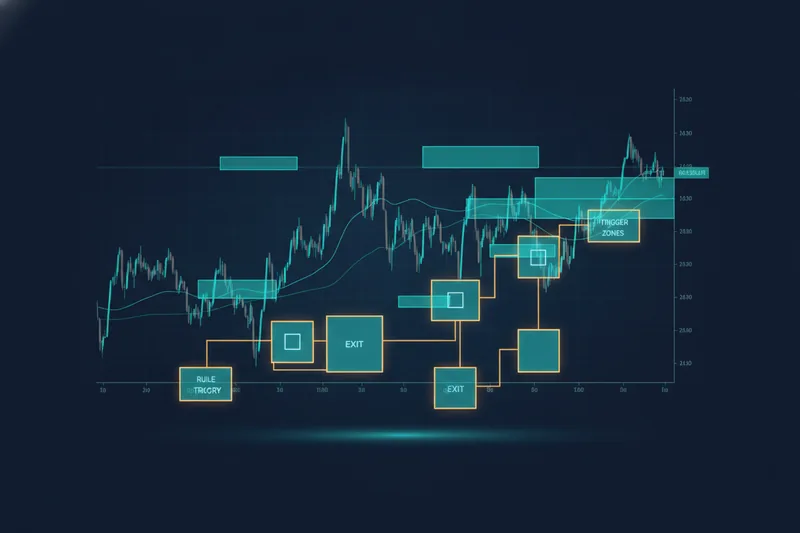
That visibility gap is the real issue for most self-directed traders: a bot can be "working" and still be a black box you don't trust. That gap between a strategy running and a trader actually understanding why it fired is the problem platforms like Quberas are built around, letting you see rule triggers directly on the chart instead of digging through parameter tables or code.
How Algo Trading Software Works
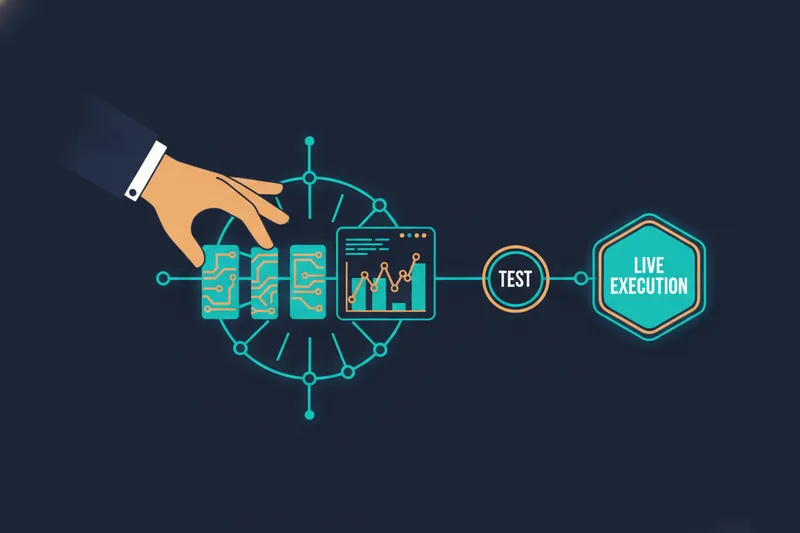
Regardless of interface, the underlying workflow is consistent: define conditions, generate signals, test them against history, then let the system trade live.
From Indicators to Trade Signals
Most strategies start with indicators — calculations derived from price and volume, such as moving averages, RSI, or volume spikes — that describe market conditions in a form a computer can evaluate. You combine these into entry/exit conditions: rules like "buy when the fast moving average crosses above the slow one" or "sell when RSI exceeds 70." When those conditions are met, the software generates a trade signal, an internal instruction that a specific condition has fired and an action should follow. Some platforms also support order types built around this logic, such as bots that add to a position or exit incrementally at set intervals rather than all at once.
Backtesting Before Going Live
Before any capital is at risk, the backtesting engine replays your conditions against historical price data to show how the strategy would have performed — win rate, drawdown, average trade size, and similar metrics. More rigorous engines test against finer-grained data than simple daily candles, since order-level or bid/ask detail can reveal execution issues that daily OHLCV data hides. Only after a strategy holds up in backtesting does it move to order execution — sending live orders to a connected broker or exchange, ideally under the same rules that were just validated historically.
No-Code vs Code-Based Algo Trading Platforms
The single biggest fork in this market is how you build the logic. Code-based platforms, such as QuantConnect, expect you to write strategies in a programming language (typically Python or C#), giving you near-unlimited flexibility but requiring real development skill to build, debug, and maintain. Other code-first tools follow the same pattern — structured environments for building, backtesting, and deploying rule-based strategies that still rely on scripting rather than a visual interface.
No-code strategy builders replace code with visual/drag-and-drop programming: you connect indicators and conditions on a canvas, and the platform translates that into executable logic behind the scenes. The trade-off isn't really "power vs simplicity" — it's how the logic is represented. Code hides logic inside variables and functions you have to read line by line; visual builders lay it out spatially, so a strategy's structure is visible at a glance, without touching an API or writing a script.
Key Features to Look For in Algo Trading Software
Once you understand the mechanics, evaluate platforms on the features that actually affect whether you can trust and refine a strategy:
- Risk management controls — configurable stop-losses and position sizing at the level of individual trades or the whole strategy, not buried in a settings menu you have to hunt for.
- Backtesting engine depth — does it use simple daily candles, or finer intraday/order-level data that reflects real execution conditions?
- Broker/exchange integrations — which venues you can actually connect to for live trading, and whether that list matches the markets you trade.
- Visual debugger — a tool that highlights the exact chart zones tied to each condition, so you can see where a rule triggered instead of inferring it from a trade log.
- Near-miss vs. triggered visualization — the ability to see how close a condition came to firing without actually triggering, which is essential for reducing noise-driven entries and tuning thresholds with evidence instead of guesswork.
That last point separates genuinely transparent tools from ones that just automate blindly: a platform that only tells you a trade happened gives you far less to work with than one that shows you why it almost didn't.
Best Algo Trading Software Compared
- QuantConnect — a code-based, multi-asset platform for traders comfortable writing Python. Extensive backtesting and data access, but a real coding investment before you can iterate on a strategy.
- Tradetron — a strategy marketplace and execution layer that also offers a drag-and-drop builder, letting users create algorithms without programming knowledge.
- AlgoTest / Zerodha Streak — no-code tools popular for rule-based options and equity strategies, built around simpler condition forms rather than a full visual debugger.
- Quberas — a no-code, transparency-first builder centered on a drag-and-drop "deal map" for entry, averaging, exit, and stop-loss logic, paired with a visual debugger and a marketplace of ready-made strategies. It targets traders who want to see exactly where a rule triggers, not just that it did.
Across all of these, pricing and subscription tiers vary by data access, backtesting depth, and whether marketplace strategies carry an added commission — details worth checking directly rather than assuming from a homepage.
Pricing Comparison
Algo trading software is typically priced in one of a few structures rather than a single universal model. Some platforms are free to use for building and even for live trading, recovering cost through wider per-trade commissions instead of a subscription — NinjaTrader, for example, has a free tier where live trading is available at higher per-contract commission rates rather than gating live execution behind a paid license. Others charge a flat monthly or annual subscription tied to features like data granularity, number of active strategies, or broker integrations. Marketplace-style platforms add a third layer: strategies published by other users often carry a performance-based cut rather than a flat fee — in copy trading contexts, lead traders commonly earn 10–20% of the net profits their followers generate, and algo strategy marketplaces tend to follow a similar performance-linked logic. When comparing platforms, check whether the quoted price includes backtesting on realistic data or only a stripped-down free tier meant to get you to upgrade before you can properly validate a strategy.
Is Algo Trading Software Profitable and Legal?
Algorithmic trading is legal for retail traders in the vast majority of markets — it's simply automated execution of the same trading decisions a manual trader could make, subject to the same broker and exchange rules around order types and market access. Profitability is a separate question, and no software makes a bad strategy good. What a solid backtesting engine does is remove guesswork: it shows you, using historical data, whether a strategy's edge is real or a coincidence of the period you eyeballed. Combined with genuine risk management — stop-losses and position sizing enforced automatically rather than relied on manually — backtesting is how you build confidence in a strategy before it touches real capital, not a guarantee that it will work going forward. Treat any platform or strategy that promises guaranteed returns as a red flag regardless of how it's automated.
How to Choose the Right Algo Trading Platform
Work through these questions in order:
- Do you want to build logic or start from something proven? If you'd rather not construct entry, exit, and stop-loss rules from scratch, look for a platform with marketplace strategies you can review and launch a ready-made strategy from, setting your own risk parameters before testing and going live.
- Can you see why a trade triggered, not just that it did? Favor tools with a visual debugger or equivalent, over ones that only report outcomes after the fact.
- Does backtesting reflect real execution? Check the granularity of historical data available, not just whether backtesting exists.
- Are risk management controls first-class, not an afterthought? Stop-loss and position sizing should be configurable at the strategy level, with clear behavior after a stop-loss fires.
- Do you want to publish and monetize a strategy yourself? If you build something that performs well, check whether the platform lets you offer it publicly or via private link and earn from others using it, and understand the commission structure before publishing.
FAQ
What is algo trading software, in simple terms? It's software that turns a set of trading rules into automatic buy and sell orders, removing manual execution from strategies you've already defined and tested.
Is no-code or code-based algo trading software better? Neither is universally better — code-based platforms like QuantConnect offer more flexibility for complex, custom logic, while no-code builders trade some flexibility for speed and visibility, letting you see and adjust a strategy's structure without learning to program.
Is algo trading actually profitable? It can be, but profitability depends entirely on the underlying strategy and risk management, not the software itself. Rigorous backtesting and visible debugging help you judge a strategy's edge honestly before risking capital, rather than guaranteeing a result.
Do I need a broker account before using algo trading software? Yes — most platforms connect to an existing broker or exchange account to place live orders, so you'll typically build and backtest first, then link a funded account for execution.
See exactly how your strategy would trigger before risking capital — build and backtest your first algo trading strategy visually with Quberas, no coding required.