Crypto Trading Bot: How Automated Trading Works | Quberas
Crypto trading bots are software programs that automatically execute trades on your behalf based on a defined set of rules — no manual clicking required. Instead of watching charts around the clock, you specify the conditions under which a trade should open or close, and the bot handles execution the moment those conditions are met. This guide covers exactly how that works: the mechanics behind automated crypto trading, the main bot types, whether bots can actually make money, and a step-by-step walkthrough for building your own strategy visually — without writing a single line of code.
What Is a Crypto Trading Bot?

A crypto trading bot (sometimes called a crypto robot) is software that connects to a cryptocurrency exchange and places buy or sell orders automatically, following a pre-defined automated trading strategy. It replaces the manual execution step — the part where you watch a chart, decide conditions are right, and click "buy" — with a rule-based system that acts in milliseconds.
Algorithmic trading is the broader term for this approach: using a set of logical rules (algorithms) to drive trading decisions rather than human judgment in the moment. Crypto bots are the retail-accessible implementation of that concept.
The core benefit is simple: crypto markets operate continuously, around the clock. A human trader sleeps; a bot doesn't. Beyond that always-on coverage, bots remove emotional decision-making — they execute the strategy you defined, not the one fear or greed pushes you toward at 3 a.m.
How Crypto Trading Bots Work
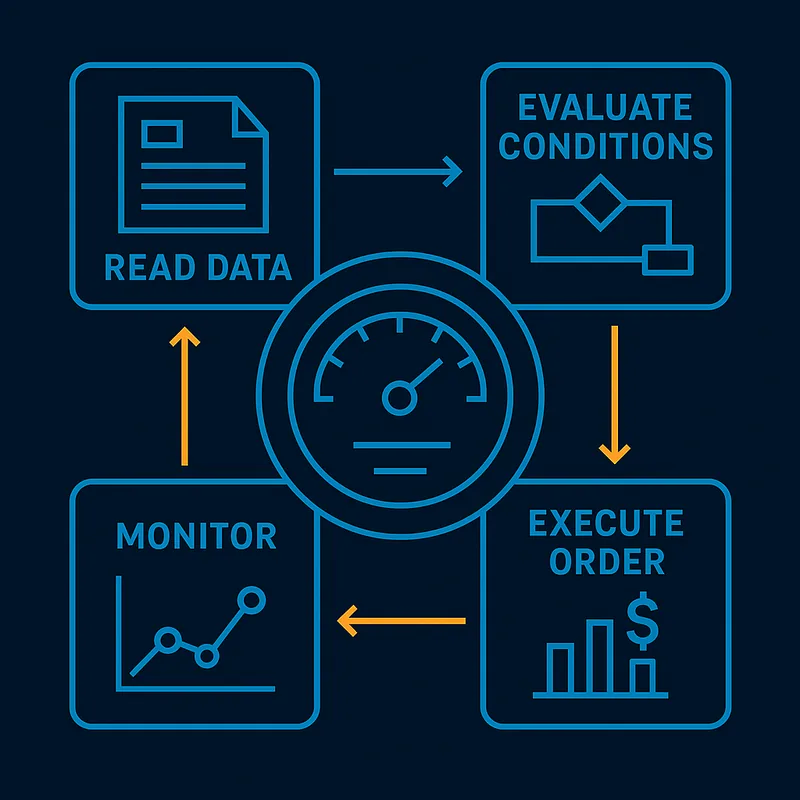
A bot isn't magic. It follows a repeating loop: read market data → evaluate conditions → act if conditions are met → wait and repeat. Understanding each step demystifies the whole system.
Reading Market Signals: Indicators and Conditions
Bots don't guess. They evaluate indicator-based conditions — mathematical calculations applied to price data. A common example is the Relative Strength Index (RSI), a momentum oscillator that measures the speed and magnitude of recent price changes on a scale of 0 to 100. Other widely used indicators include moving average crossovers, Bollinger Bands, and volume-based signals.
You define rules like: "If the 14-period RSI drops below 30 and the 50-period moving average is trending upward, open a long position." The bot checks that condition on every new candle or tick. When the condition is true, it acts. When it isn't, it waits.
Entry and exit logic are the two sides of every strategy. Entry conditions define when to open a trade; exit conditions define when to close it — whether at a profit target, a trailing stop, or a time-based rule. Both need to be explicitly defined before the bot can function.
The key distinction between a transparent bot and a black-box one is whether you can see where those rules trigger on a chart. Opaque platforms tell you a bot is running; transparent ones show you exactly which candle triggered which condition.
Connecting to an Exchange

A bot doesn't have its own trading account. It connects to your existing exchange account through an API connection — a secure link that gives the bot permission to read your account data and place orders on your behalf, without exposing your login credentials.
Exchange integration via API is a standard mechanism supported by many major platforms. You generate an API key in your exchange settings, paste it into the bot platform, and the connection is live. You control what permissions the API key carries — most traders grant trade execution rights but not withdrawal rights, as a security measure. Always review the specific terms and permissions for any exchange you connect to.
From Condition to Order: The Execution Loop
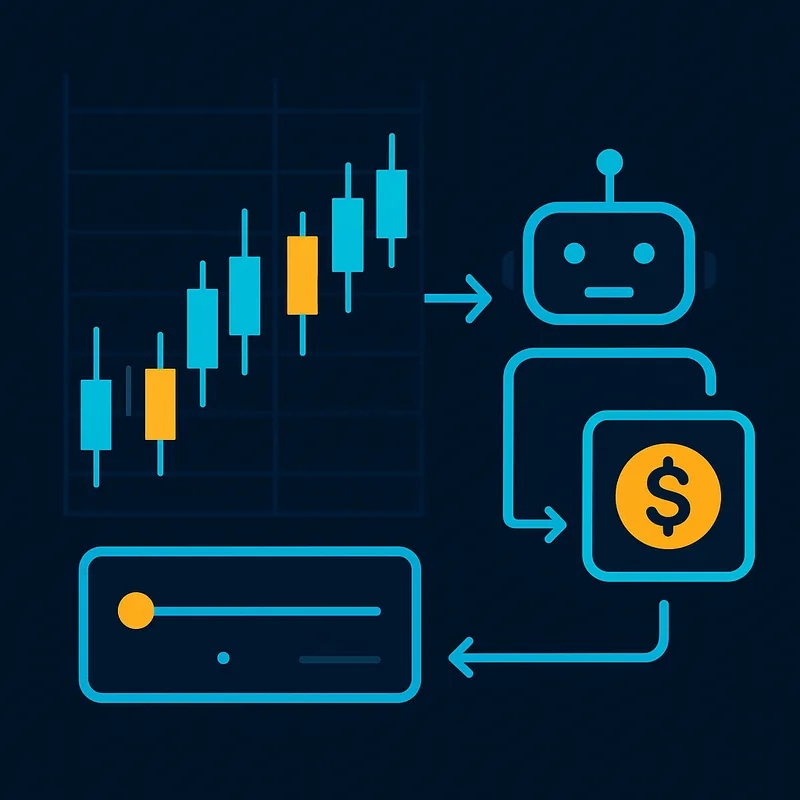
Once connected, the bot runs its evaluation loop continuously. When an entry condition is satisfied, it sends an order to the exchange — market, limit, or conditional, depending on your configuration. The exchange fills the order (subject to liquidity and price), and the bot logs the trade and begins monitoring exit conditions.
This loop — check → trigger → execute → monitor — runs without your involvement. The quality of that loop depends entirely on the quality of the rules you defined, which is why visual transparency into bot logic matters: you need to verify the rules are correct before trusting the bot with real capital.
Types of Crypto Trading Bots
Different strategies call for different bot architectures. Here are the four main types:
DCA Bots
A DCA (dollar-cost averaging) bot spreads a position across multiple buy orders at declining price levels. Instead of buying a full position at once, it buys a base order, then adds "safety orders" as the price drops — lowering the average entry price. When the price recovers to a target percentage above the average, the bot closes the full position for a profit.
- Best for: Volatile markets where price frequently dips before recovering; beginners who want a structured, lower-risk entry approach.
- Watch out for: Extended downtrends where the price keeps falling past all safety orders.
Grid Bots
A grid bot places a ladder of buy and sell orders at fixed price intervals above and below the current price, creating a "grid." As price oscillates within the range, the bot buys low and sells high repeatedly, capturing small profits on each swing.
- Best for: Sideways or range-bound markets; traders who want passive income from volatility without predicting direction.
- Watch out for: Strong trending markets that break out of the grid range entirely.
Arbitrage Bots
An arbitrage bot exploits price differences for the same asset across different exchanges or trading pairs. It buys where the price is lower and simultaneously sells where it's higher, locking in a near-risk-free spread.
- Best for: High-frequency, low-margin strategies; traders with accounts on multiple exchanges.
- Watch out for: Execution speed requirements are extreme — small latency advantages matter, and fees can erase the spread quickly.
Signal-Based and Indicator Bots
A signal-based bot acts on external triggers — alerts from TradingView, third-party signal services, or custom webhook events. An indicator bot (a subset of this category) evaluates technical indicators directly and generates its own signals internally.
- Best for: Traders who already have a working technical analysis approach and want to automate it precisely.
- Watch out for: Signal quality is everything — garbage signals produce garbage trades, regardless of how well the bot is configured.
For most beginners, DCA bots offer the most forgiving entry point: the logic is intuitive, the risk is spread across multiple orders, and the strategy performs reasonably well in the volatile conditions common to crypto markets.
Can Crypto Bots Make Money?
Yes — but the bot itself isn't what generates the profit. The strategy does.
Bot profitability depends on three factors: the quality of the underlying strategy logic, the market conditions the bot operates in, and how well the bot is configured for those conditions. A well-designed DCA strategy in a ranging market can produce consistent returns. The same strategy in a sustained bear market will accumulate losing positions.
This is why backtesting — running your strategy rules against historical price data to see how they would have performed — is the most important step before going live. Backtesting doesn't guarantee future results, but it reveals obvious flaws: rules that trigger too frequently, stop-losses set too tight, or exit targets that were never reached in the test period. It's the primary risk-reduction step available to any bot trader.
Poorly configured bots are a real risk. A bot with no stop-loss, overly aggressive averaging rules, or entry conditions that fire on every candle will lose money systematically — and do so faster than a human trader would, because it executes without hesitation.
The honest answer: bots are tools that execute strategy, not sources of alpha on their own. A trader who doesn't have a profitable manual strategy won't automatically have a profitable bot. What bots add is consistency, speed, and continuous execution — applied to a strategy that already makes logical sense.
Are Crypto Bots Legal?
Automated crypto trading is widely practiced and generally accepted across the industry, but the legal and regulatory picture varies by jurisdiction and platform. This is general information, not legal advice — if you're trading at significant scale or operating in a regulated market, consult a legal professional familiar with your local financial regulations.
The important distinction is between legal automation and market manipulation. Running a bot that executes your own strategy is a different matter from using bots to artificially inflate volume, spoof order books, or coordinate price movements across accounts — practices that regulators and exchanges broadly treat as abusive regardless of how they're executed.
Exchange terms of service are the most immediate constraint for most retail traders. Exchanges set their own rules about automated trading, and those rules differ. Some platforms explicitly support API-based bot trading; others restrict certain behaviors such as high-frequency order placement. Always read the ToS for any exchange you connect to before deploying a bot.
Responsible use means running bots on your own accounts, with your own capital, within the rules of the platforms you use — which is the approach the vast majority of retail bot traders take.
Choosing the Best Crypto Trading Bot: What to Look For
There's no single "best" bot for every trader. The right choice depends on your technical background, your strategy type, and how much visibility you need into what the bot is actually doing.
No-Code vs. Code-Based Bots
Code-based platforms like Freqtrade or Hummingbot are open-source and highly flexible — but they require Python knowledge to configure strategies, comfort with command-line interfaces, and ongoing maintenance. They're powerful for developers; they're a steep barrier for traders who aren't programmers.
No-code strategy builders let you define the same logic — entry conditions, exit rules, stop-losses, averaging orders — through a visual interface rather than code. The trade-off is less raw flexibility, but the gain is speed of iteration and full transparency into what you've built. For traders whose edge is market knowledge rather than programming skill, no-code is the more practical path.
Key Features to Evaluate Before You Commit
When assessing any bot platform, check for:
- Visual strategy builder: Can you see your logic laid out clearly, or are conditions buried in parameter fields?
- Visual debugger: Does the platform show you where your rules trigger on the actual chart, so you can verify the logic before going live?
- Backtesting capability: Can you test your strategy against historical data within the platform, without exporting data elsewhere?
- Exchange integration breadth: Does it connect to the exchanges you actually use?
- Condition complexity: Can you build nested logic — "if A and B, but not C" — or are you limited to simple single-condition triggers?
- Ease of use for non-coders: Is the interface designed for traders, or does it assume programming familiarity?
Platforms that bury strategy logic in configuration files or show only a P&L dashboard without explaining why a trade triggered are black-box tools — fine if you trust the algorithm, problematic if you want to understand and improve your own strategy.
How to Build an Automated Crypto Strategy Without Coding
Here's the full workflow for building a strategy visually, using a no-code strategy builder with a drag-and-drop deal map interface — a visual canvas where each component of your strategy (entries, averaging orders, exits, stop-losses) connects as a logical flow you can inspect and edit.
Step 1: Define Your Entry Conditions
Start by selecting the indicators that define your entry signal. In a visual builder, this means choosing indicators from a library (RSI, MACD, moving averages, volume, price crossovers) and setting the condition logic: "RSI(14) crosses below 35" or "50 EMA is above 200 EMA."
You can layer multiple conditions using AND/OR logic — for example, requiring both an RSI signal and a volume confirmation before the bot opens a position. The condition builder displays this as a visual puzzle of connected blocks, not a code string.
Step 2: Set Averaging, Exit, and Stop-Loss Rules
Once entry is defined, configure what happens after the position opens:
- Averaging orders (for DCA strategies): set the price deviation percentage that triggers each additional buy, and the size of each order.
- Exit conditions: define your take-profit target — either a fixed percentage above the average entry price or a condition-based exit (e.g., RSI crossing back above 60).
- Stop-loss: set the maximum loss threshold at which the bot closes the position regardless of other conditions. This is the most important risk control in any strategy.
Each of these components connects visually in the deal map, so you can trace the full logic path from entry to exit in one view.
Step 3: Visualize and Debug Your Logic on the Chart
Before testing with real data, use the visual debugger to see your conditions highlighted directly on the price chart. Each zone where an entry condition would have triggered is marked; each exit point is visible. This step answers the question every bot trader should ask: "Is this actually doing what I think it's doing?"
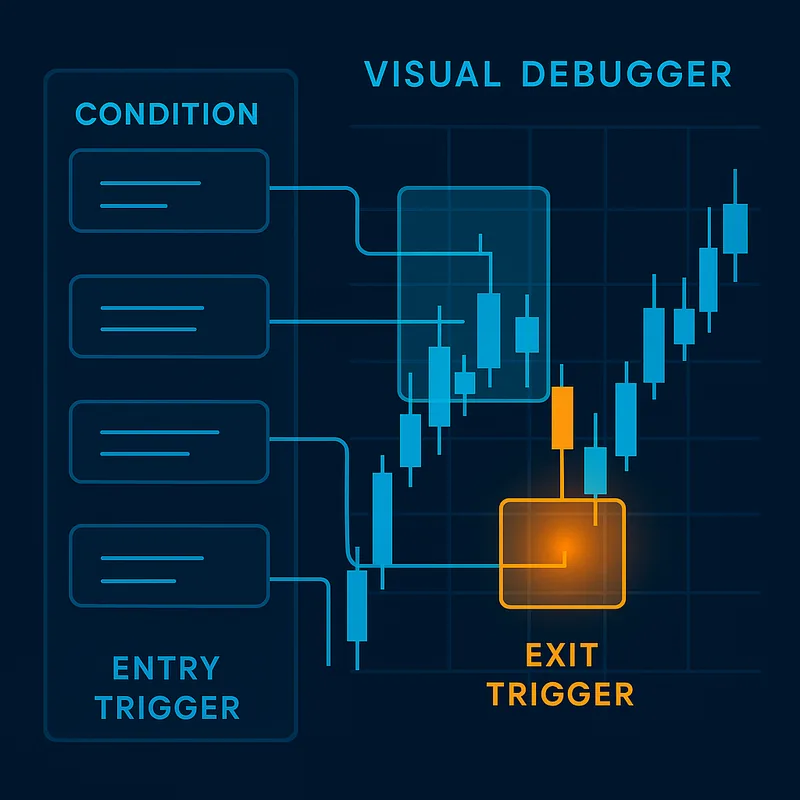
Seeing rule triggers on the chart catches errors that parameter review misses — conditions firing too frequently, entry signals clustering in unfavorable zones, or stop-losses placed at levels that would have been hit on normal volatility.
Step 4: Backtest Before You Go Live
Run the strategy against historical price data for the asset and timeframe you intend to trade. Review the key outputs: total return, win rate, maximum drawdown, number of trades, and average trade duration.
Look for strategies with a reasonable win rate, a maximum drawdown you're comfortable holding through, and enough trade occurrences in the test period to be statistically meaningful (a strategy that triggered twice in six months isn't validated). Adjust conditions, re-test, and iterate until the results are consistent.
Backtesting is not a guarantee — past performance doesn't predict future results — but it eliminates strategies with obvious structural flaws before they cost you real money.
Step 5: Launch and Monitor
Connect your exchange account via API, set your position size and capital allocation, and activate the bot. Once live, monitor the first few trades to confirm the bot is executing as the backtest suggested. Check that orders are filling at expected prices, that averaging orders are triggering at the right deviations, and that exits are closing positions correctly.
Ongoing monitoring matters: market conditions change, and a strategy optimized for a ranging market may need adjustment when a trend develops. Treat launch as the beginning of an iteration cycle, not a "set and forget" endpoint.
Getting Started with Automated Crypto Trading Today
The barrier to automated crypto trading has dropped significantly. You no longer need to write Python, configure a server, or trust a black-box algorithm you can't inspect. Visual no-code tools make it possible to build a strategy with real logical depth — nested conditions, DCA rules, custom exits — and verify every rule on the chart before risking capital.
What hasn't changed: strategy quality still drives results. A bot executes your logic faster and more consistently than you can manually, but it can't improve logic that doesn't work. Invest time in defining clear entry and exit conditions, backtest rigorously, and start with position sizes you're comfortable losing while you validate the strategy in live conditions.
Ready to build your first automated crypto strategy without writing code? Try Quberas's visual strategy builder — define your conditions, see them trigger on the chart, backtest, and launch.