E-mini Futures Explained: Trade Systematically
E-mini futures are standardized, exchange-traded contracts that let traders speculate on or hedge major stock indexes — the S&P 500, Nasdaq-100, and Russell 2000 among them — using a fraction of the capital and contract size required by the original full-size futures. They trade on CME Group, the exchange that designed them, and they're the instrument most retail futures traders actually use, since the full-size versions were built for institutional balance sheets, not individual accounts. This guide covers how the contracts work — specs, margin, expiration — how the major e-mini products differ, and how to move from watching price action to trading a rule-based system you've actually tested.
What Are E-mini Futures?
A futures contract is a standardized agreement to buy or sell an underlying asset — here, the value of a stock index — at a set price on a future date. Unlike a stock, you're not buying ownership of anything; you're taking a position on where the index will be, and the contract is settled in cash rather than by delivering shares.
CME Group launched the E-mini S&P 500 (ES) in 1997, sized at one-fifth the value of the original S&P 500 futures contract, specifically to make index futures accessible to traders who couldn't justify the margin and tick value of the full-size contract. The "e" stands for electronic — e-minis trade almost entirely on CME's Globex platform rather than in a physical pit, which is part of why they built the near round-the-clock liquidity retail traders rely on today. Once you understand how a single contract's mechanics work, the harder problem is turning that knowledge into consistent, repeatable rules instead of reacting to price in the moment — which is the gap a visual, no-code builder like Quberas is designed to close, letting you translate a futures thesis into logic you can see and test before risking capital.
E-mini vs Full-Size Futures Contracts
The original S&P 500 futures contract still trades, but at five times the notional value of the ES. Full-size contracts require correspondingly larger margin and carry bigger dollar swings per tick, which is why they're used almost exclusively by institutions and large funds. E-minis exist precisely to strip that barrier down — smaller contract, smaller margin, same index exposure, same trading hours.
How E-mini Futures Contracts Work
Every e-mini contract shares the same governing mechanics, whichever index it tracks — the details below apply across ES, NQ, and the rest.
Tick Size and Point Value
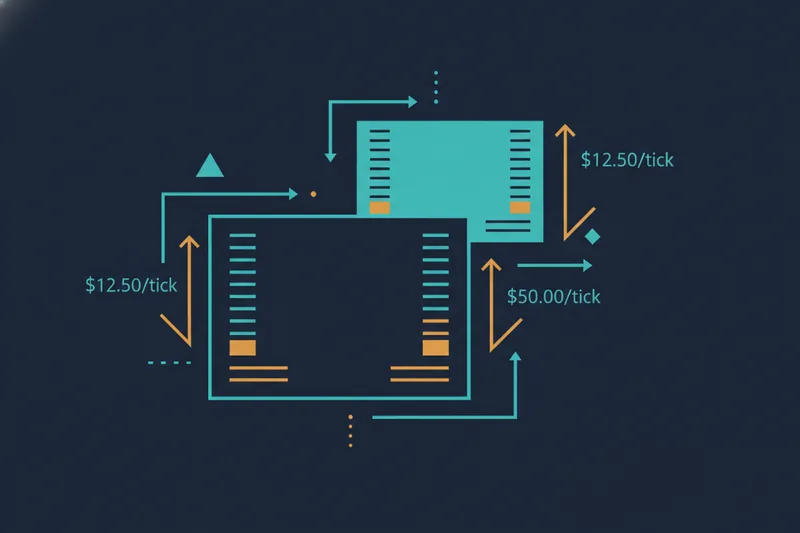
The ES moves in minimum increments called ticks. For the E-mini S&P 500, one tick is 0.25 index points, and each full point of movement is worth $50 to the position — so a one-tick move equals $12.50, and a 10-point move on one contract is $500. This point value is fixed by CME Group and is what actually determines your profit, loss, and risk per trade — not the index's raw price level.
Contract Months and Expiration Cycles
E-minis trade on a quarterly cycle — March, June, September, December — with each contract carrying an expiration date after which it stops trading and cash-settles against the index. Most active trading concentrates in the front-month contract; positions are typically rolled to the next month a few days before expiration to avoid the thinning liquidity that shows up as the current contract nears its final sessions.
Trading Hours and After-Hours Liquidity
E-minis trade nearly 24 hours a day, five days a week, with a short daily maintenance break. Liquidity — how easily you can enter and exit at a fair price — is heaviest during the regular U.S. equity session and thins noticeably overnight, which widens effective spreads and makes fills less predictable outside those hours.
Margin and Leverage Basics
Margin requirements are the good-faith deposit your broker holds to open a position — far less than the contract's full notional value, which is what creates leverage: control over a large index exposure with a comparatively small deposit. That leverage cuts both ways — it amplifies gains and losses at the same rate, which is why margin and position sizing deserve as much attention as entry timing.
E-mini vs Micro E-mini Futures
Micro E-mini (MES) contracts are exactly one-tenth the size of the standard ES — one-tenth the point value, and proportionally lower margin. If the ES moves $50 per point, the MES moves $5. That ratio holds across CME's other micro products too.
The practical difference is capital and precision. A trader with a smaller account, or one who wants to size a position in finer increments while testing a new strategy, is better served by MES — it allows scaling a position up or down a single micro contract at a time rather than jumping in five-point increments. Traders running larger, already-validated strategies with defined capital tend to use standard E-minis, where a single contract carries more weight per trade.
E-mini S&P 500 vs SPX Index
The SPX index — the S&P 500 itself — isn't directly tradable; you trade it through products derived from it, and ES futures are one of those, alongside SPX options and index funds. The distinction matters for three reasons: leverage, access, and tax treatment.
ES gives you leveraged, margin-based exposure with near 24-hour access, letting you react to overnight news the cash index and its options can't touch outside regular hours. SPX options settle in cash, with the settlement value depending on whether the contract is AM- or PM-settled, and carry their own tax and settlement conventions distinct from futures. Traders sometimes conflate the two because both track the same 500 companies, but the mechanics — margin, hours, and how gains are taxed — differ enough that choosing between them should be a deliberate decision, not a default.
Other Major E-mini Contracts: NQ and Russell 2000
Beyond the S&P 500, two other e-mini contracts see consistent retail volume:
- NQ (E-mini Nasdaq-100) tracks the 100 largest non-financial companies on the Nasdaq, skewing heavily toward technology and growth names — it tends to move with more volatility per point than the ES because of that sector concentration.
- Russell 2000 E-mini tracks small-cap U.S. companies, giving exposure to a different part of the market cycle than the large-cap-heavy ES and NQ, often with distinct behavior around economic data releases.
Choosing among them is really a question of which index exposure and volatility profile fits your strategy — a trend-following approach built for NQ's sharper swings won't necessarily transfer cleanly to the Russell's small-cap dynamics.
Who Trades E-mini Futures?
Three broad groups make up e-mini volume. Day traders use the contracts' liquidity and leverage to take short-duration positions within a session. Institutional and systematic desks trade e-minis for hedging and index exposure at scale, running strategies built and monitored by dedicated quant teams. Retail algorithmic traders are the fastest-growing segment — individuals building and running their own rule-based strategies rather than trading on discretion alone.
That third group exists in meaningful numbers now largely because tools that were once institutional-only have become accessible to individual traders. A retail trader with a clear, testable rule set no longer needs a quant team to backtest and automate it — which is the specific gap no-code strategy builders are designed to fill.
How to Trade E-mini Futures: Strategies and Risk Management
From Manual Execution to Systematic Rules
Most traders start manually — watching charts, reacting to price. The problem is consistency: the same setup gets traded differently depending on mood, fatigue, or a losing streak. Common e-mini approaches include trend-following (riding a sustained directional move), mean-reversion (fading extended price away from an average), and scalping, which works on very short timeframes — from one-minute to fifteen-minute charts — where outcomes are shaped more by execution and spread than by the size of the underlying move. Day trading around e-minis also spans range trading, gap trading, and breakout trading as distinct approaches beyond scalping — each demands different entry logic and different risk tolerance.
Stop-loss placement and position sizing are what keep any of these approaches from becoming account-ending. A widely cited discipline framework caps risk at 3% per individual trade and 5% across all open positions at once, paired with a minimum 7% profit-to-loss target on winners — the specific numbers matter less than having a fixed rule you follow every time, rather than deciding in the moment.
Backtesting Before Risking Capital
Before any rule set touches live capital, it needs to be tested against historical price data to see how it would have performed — and backtesting alone isn't the finish line. Both backtesting against history and forward testing in real-time conditions are considered necessary steps before a strategy is ready for real money, since live order flow and slippage don't always match historical simulation.
Building and Debugging Strategy Logic Visually, Without Code
This is where translating a manual approach into a system usually stalls — most traders can describe their rules in plain language but not in code. Quberas is built around that specific handoff: you construct a strategy as a deal map, a visual sequence of entry conditions, averaging orders, exits, and stop-losses, connecting price, indicator, and volume conditions through a puzzle-style condition builder instead of writing logic by hand. A visual debugger then highlights the exact chart zones tied to each condition, showing not just where a rule triggered but how close it came to triggering when it didn't — which is how you tell a genuinely weak setup from one that just needs a threshold adjustment.
Where to Find Live E-mini Prices and Charts
Real-time e-mini quotes and charting are available through several standard sources: brokers' native platforms, dedicated charting services, and general financial data sites. Yahoo Finance provides real-time streaming quotes across many exchanges rather than only delayed data, and StockCharts.com's free plan includes real-time data for US markets specifically — useful starting points if you don't already have a broker feed running.
Live charts matter for more than just watching price, though. The same historical data underlying those charts is what you'll use to backtest and refine a rule set before it goes live — so treat the chart as the raw material for strategy design, not just a screen to stare at.
FAQ: E-mini Futures Questions Traders Ask
What are typical margin requirements for e-mini futures? Margin is set by the exchange and your broker and varies by contract and by whether you're holding overnight or trading intraday — intraday margin is generally lower than overnight margin. Check your broker's current schedule rather than relying on a fixed figure, since these are adjusted periodically.
What are the best times to trade e-minis? Liquidity is highest during the regular U.S. equity session, which is when spreads are tightest and fills most predictable; overnight hours see real but thinner activity.
Should a beginner start with E-mini or Micro E-mini contracts? Micro E-mini contracts, given their smaller size and lower capital requirement, generally give a newer trader more room to size positions conservatively while a strategy is still being validated.
How do I start automating an e-mini strategy without coding? Start with the rules you already trade manually — your entry trigger, exit trigger, and stop-loss — and rebuild them as a visual deal map with conditions on price, indicators, or volume. Backtest that map against historical data, then use a visual debugger to check where conditions almost triggered versus where they actually did, tightening thresholds before you commit real capital.
See how to turn your e-mini futures rules into a visual, backtested strategy — try Quberas free and build your first deal map without writing code.