Automated Cryptosystem: Crypto Ciphers to Trading Systems
The term automated cryptosystem has two distinct lives on the internet: one in academic cryptography, where it describes systems that handle encryption automatically, and one in trading forums, where it's shorthand for an automated crypto trading system. This guide covers both — plainly — so you leave knowing exactly what each means and how to build the trading version yourself without writing a line of code.
What Is a Cryptosystem?
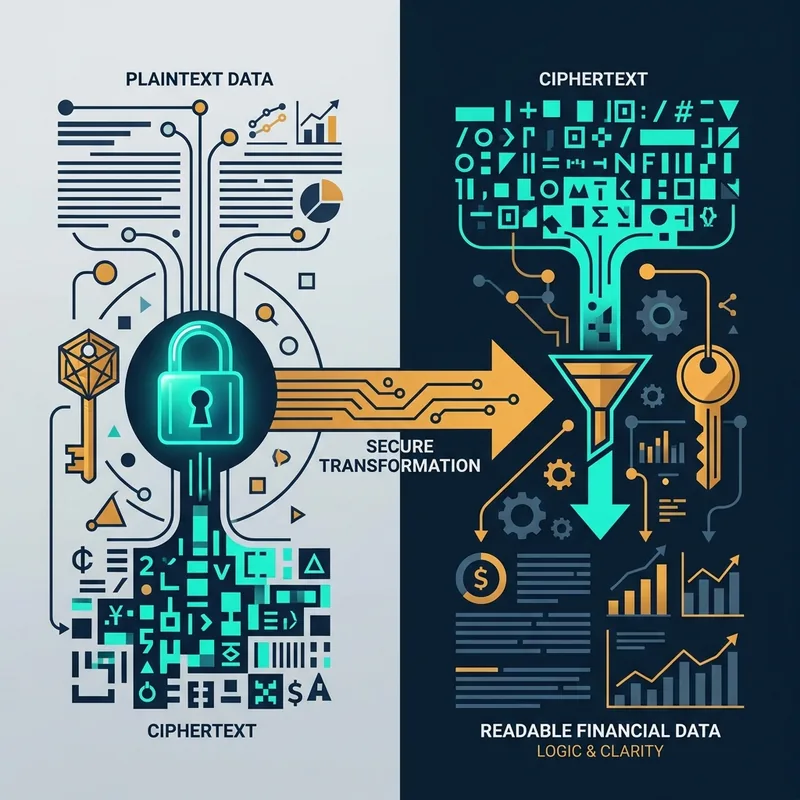
A Simple Definition
A cryptosystem is a set of algorithms and rules that transforms readable data (plaintext) into a protected, unreadable form (ciphertext) and back again. Think of it as a locked box with a defined procedure for locking and unlocking: the procedure is the cryptographic algorithm, and the key is the secret that controls access.
At its core, a cryptosystem combines encryption and decryption logic with one or more encryption keys — the values that determine the specific output of those algorithms. Change the key, and the same algorithm produces completely different ciphertext.
Classic Examples: From Cipher Machines to RSA
The Enigma machine is one of history's most famous cipher machines. Used by Nazi Germany during World War II, it was an electromechanical cryptosystem: operators set physical rotors (the key), typed a message, and the machine output scrambled letters. The rules were fixed; only the rotor configuration changed. Breaking Enigma required figuring out the key, not rewriting the machine.
Modern cryptosystems are mathematical rather than mechanical. RSA (Rivest–Shamir–Adleman) is the canonical example of public key cryptography — a system where two mathematically linked keys are used: a public key anyone can see, and a private key only the owner holds. Data encrypted with the public key can only be decrypted with the private key. RSA underpins HTTPS, email signing, and much of the internet's security infrastructure. The algorithm is public knowledge; security comes entirely from the secrecy of the private key.
What Makes a Cryptosystem "Automated"?
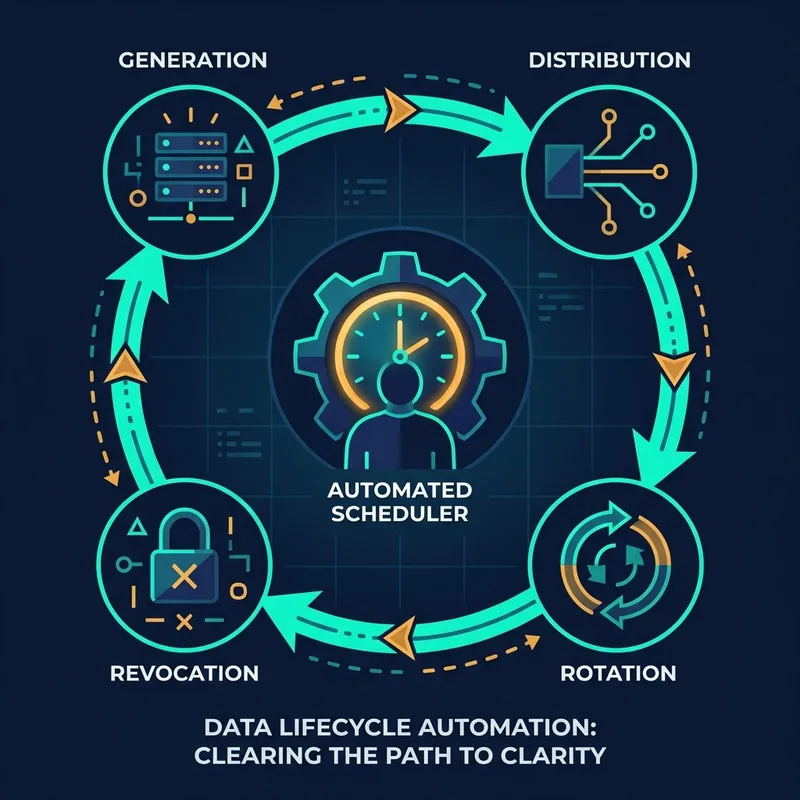
The Encryption Key Lifecycle
The word "automated" in this context refers largely to how keys are managed. Every encryption key passes through a series of management stages — commonly including generation (creating the key), distribution (delivering it securely to authorized parties), rotation (replacing it on a schedule before it can be compromised), and revocation (invalidating it if a breach is suspected), among others depending on the implementation. In practice, key lifecycle management can be more granular than any single list captures, and different frameworks define the stages differently.
In a manual approach, a human administrator handles each of these steps — generating keys by hand, distributing them via secure channels, and tracking expiry dates in a spreadsheet. That works at small scale. It breaks down fast when you're managing thousands of keys across cloud services, databases, and APIs.
Automated vs. Manual Key Management
A key management system (KMS) — such as AWS KMS or Google Cloud KMS — automates the key lifecycle. Keys are generated on a schedule, rotated automatically at defined intervals, and revoked instantly when a policy is triggered, all without a human in the loop.
The practical advantages are significant. Automated encryption eliminates the latency of waiting for an administrator to act and removes the human error that comes with manual tracking. A TLS handshake — the encrypted connection your browser negotiates with a website in milliseconds — is a live example: certificates are issued, validated, and renewed automatically. Cloud storage platforms encrypt and re-encrypt data at rest without user intervention. Payment systems rotate keys on transaction cycles measured in seconds.
The contrast with manual key management is stark: manual processes introduce lag, inconsistency, and single points of human failure. Automation makes the system deterministic — given a trigger condition, the same action always follows.
Post-Quantum Cryptography and the Next Wave of Automation

Why Quantum Computing Changes the Equation
RSA and most current public-key systems derive their security from mathematical problems — like factoring very large numbers — that classical computers cannot solve in any practical timeframe. Quantum computers, using algorithms like Shor's algorithm, could theoretically solve those problems orders of magnitude faster, rendering RSA and similar schemes vulnerable.
Post-quantum cryptography is the field developing cryptographic algorithms designed to resist attacks from quantum computers. The U.S. NIST (National Institute of Standards and Technology) has been running a multi-year standardization process to identify and certify these algorithms, publishing its first finalized post-quantum standards in 2024. The selected algorithms rely on mathematical problems — such as lattice-based problems — that are believed to be hard for both classical and quantum machines.
Can AI Be Used in Cryptography?
The transition to post-quantum standards introduces a new automation challenge: organizations need to identify every place they use vulnerable cryptography and migrate it. This is where crypto-agility — the ability to swap cryptographic algorithms without redesigning entire systems — becomes critical. Automated migration tools scan codebases and infrastructure to flag deprecated algorithms and suggest replacements.
AI-assisted pattern recognition plays a supporting role here: machine learning models can identify cryptographic usage patterns across large codebases faster than manual audits, flag anomalies in key usage, and help prioritize migration risk. AI does not replace the underlying cryptographic algorithms — it helps manage the operational complexity of running and transitioning them at scale.
The Other "Automated Cryptosystem": Automated Crypto Trading Systems
Rule-Based Logic: The Common Thread
Here is where the vocabulary gap lives. Many traders searching "automated cryptosystem" are not looking for RSA or KMS — they mean an automated system for trading cryptocurrency. The confusion is understandable: "crypto" does double duty as shorthand for both cryptography and cryptocurrency.
The conceptual overlap is real, though. Both a cryptographic system and a trading strategy automation system are fundamentally rule-based systems: a defined set of conditions leads to a deterministic output. In cryptography, the condition is "data arrives" and the output is "encrypt it with this key." In trading, the condition is "RSI crosses below 30 while price is above the 200-day moving average" and the output is "open a long position."
What an Automated Crypto Trading System Actually Contains
A proper automated crypto trading system is built from the same logical DNA as any rule-based system. Its components map cleanly:
- Entry conditions — the specific indicator states, price levels, or volume signals that must be true before a trade opens. These are the algorithm's input conditions.
- Exit rules — the conditions under which a profitable trade closes. Mirror logic to entry, but in reverse.
- Stop-loss — a hard rule that closes a losing trade at a defined threshold, preventing runaway losses. This is the system's error-handling routine.
- Averaging orders (optional) — rules for adding to a position as price moves, following a defined schedule or condition.
Traders who use the phrase "automated cryptosystem" loosely are describing exactly this: a system where human judgment is encoded into rules upfront, and the bot executes those rules without emotion or hesitation. The difference from a cryptographic system is the domain — financial markets instead of data security — not the underlying logic structure.
Code-heavy trading bots require writing that logic in Python, JavaScript, or a proprietary scripting language. The barrier is high: a trader who understands markets deeply may have no programming background. Visual no-code strategy builders solve this by letting traders define the same rule-based logic through a graphical interface instead of syntax.
How to Build Your Own Automated Crypto Trading System Without Code

Step 1: Define Your Entry and Exit Conditions
The first step is translating your trading thesis into explicit, testable conditions. Quberas's condition builder works like a logic puzzle: you select indicators (RSI, MACD, Bollinger Bands, volume), set the comparison (crosses above, is greater than, equals), and chain conditions together with AND/OR operators to build nested logic.
For example: "Enter long when RSI(14) crosses above 30 AND price is above EMA(200)." That's two conditions linked by AND — both must be true simultaneously. You define exit rules the same way: "Close when RSI crosses above 70 OR price drops 3% from entry." Stop-losses are set as a fixed percentage or price level, applied automatically to every trade the bot opens.
Step 2: Visualize the Logic on the Chart

Defining conditions in text or code gives you no immediate feedback on whether they make sense. The visual debugger highlights the exact chart zones where each condition fires — you see colored overlays on historical price data showing precisely when your entry rule would have triggered, when the exit rule would have closed the trade, and where the stop-loss would have activated.
This is the "see exactly how your strategy works on the chart" principle in practice. If your entry condition fires 40 times in a month but 35 of those are during low-volume overnight sessions you never intended to trade, you see that immediately and adjust the condition before a single dollar is at risk.
Step 3: Backtest and Refine Before Going Live
Backtesting runs your defined rules against historical price data to produce a performance record: win rate, average profit per trade, maximum drawdown, and total return over the test period. It does not guarantee future results, but it does reveal whether your logic has any historical edge and where it breaks down.
The iteration workflow is tight: adjust a condition in the builder → re-run the backtest → compare results → adjust again. Because the interface is visual and no-code, this loop takes minutes rather than the hours a code-based approach requires. Once the backtest results meet your criteria, you move the strategy to live execution — with the same rules, unchanged, running automatically.
Frequently Asked Questions
What is an example of a cryptosystem? RSA is the most widely cited modern example — a public-key cryptosystem used in HTTPS and email security. AES (Advanced Encryption Standard) is the dominant symmetric cryptosystem used for encrypting stored data. Historically, the Enigma machine is the most famous example of a mechanical cryptosystem.
What is a famous ciphering machine? The Enigma machine, used by Germany in World War II, is the most well-known cipher machine in history. Its breaking by Allied cryptanalysts at Bletchley Park — including Alan Turing — is considered a turning point in the war and a founding moment of modern computer science.
Can AI be used in cryptography? Yes, in operational and management roles. AI assists with identifying vulnerable cryptographic implementations, detecting anomalous key usage patterns, and automating the migration to post-quantum algorithms. AI does not replace cryptographic algorithms themselves — the math remains the security foundation.
What does "automated cryptosystem" mean for traders? For traders, the phrase typically means an automated crypto trading system: a rule-based bot that executes trades based on predefined conditions (indicators, price levels, stop-losses) without manual intervention. It shares the rule-based, deterministic logic of a cryptographic system but operates in financial markets rather than data security.
Do I need to code to build an automated crypto trading system? No. Visual no-code platforms let you define entry conditions, exit rules, and stop-losses through a graphical interface, see where those rules trigger on a chart, and backtest the strategy against historical data — all without writing code.
Ready to build your own automated crypto trading system without writing code? Try Quberas's visual strategy builder — define your rules, see them fire on the chart, and backtest before you go live.