Robinhood Trading Platform: Features & Fees
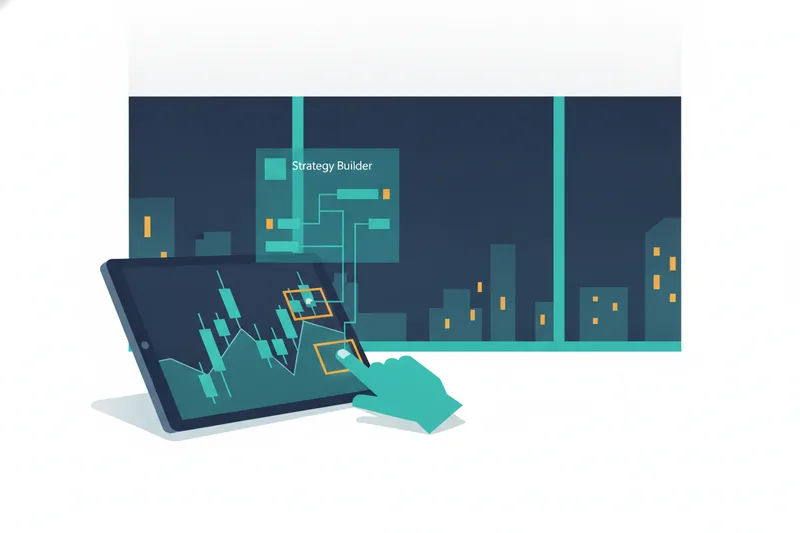
Robinhood is a mobile-first brokerage app that lets US retail investors trade stocks, ETFs, options, and cryptocurrency without paying a per-trade commission. It built its reputation on stripping away the account minimums and flat fees that used to gate access to the markets, and on a phone-native interface that made buying a stock feel as simple as any other app purchase. This piece breaks down what Robinhood actually offers, what it costs, how safe and reliable it really is, and — because tapping "buy" and "sell" by hand only gets a trader so far — how to layer systematic, backtested strategy logic on top of a Robinhood account instead of trading purely on gut feel.
What Is Robinhood?
Robinhood is a US-based online brokerage, launched in 2013, built around commission-free trading: no fee charged per trade on stocks, ETFs, or options contracts. It operates primarily as a mobile trading app, though a web platform exists too, and it removed the account minimums that traditionally kept smaller investors out of full-service brokerages.
Through Robinhood, a trader can buy and sell stocks and ETFs (exchange-traded funds, baskets of securities that trade like a single stock), trade options contracts, and buy fractional shares — a slice of a share, priced in dollars rather than whole units, useful when a single share of a company costs more than a trader wants to commit. Robinhood also supports cryptocurrency trading in most states.
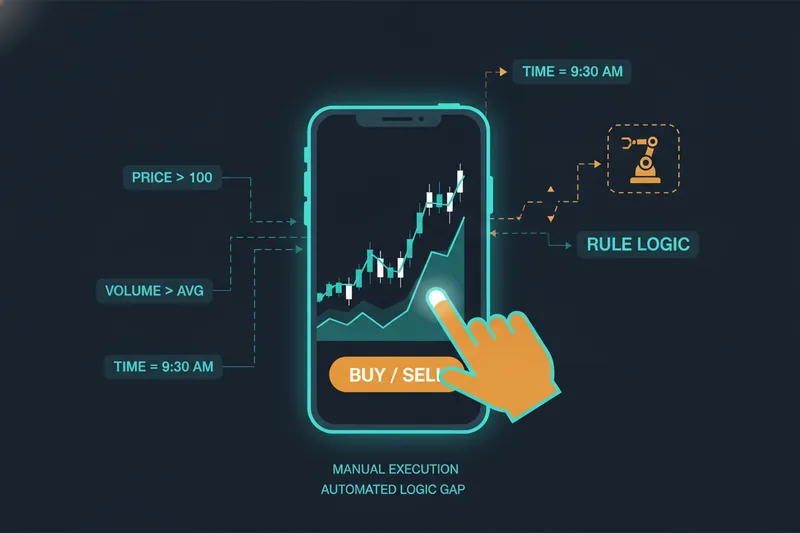
What Robinhood does not do natively is let you define trading rules that execute themselves. Every order — entry, exit, adding to a position — is a manual tap, made in the moment, based on whatever you're seeing on the chart right then. That's precisely the gap that visual, no-code tools such as Quberas are built to close for traders who want their decisions to follow tested rules rather than the mood of the moment.
Key Features & Tools
Investing in Stocks, ETFs, and Fractional Shares
Robinhood's core offering is straightforward equity and ETF investing. You can search a ticker, view a basic price chart, and place a market or limit order in a few taps. Fractional shares let you invest a fixed dollar amount — say $20 — into a stock or ETF regardless of its per-share price, which matters for building diversified positions with limited capital.
Options Trading on Robinhood
Robinhood also offers options trading: contracts that give the right (not the obligation) to buy or sell a stock at a set price by a set date. The app displays an options chain with strike prices and expiration dates and supports both single-leg and multi-leg strategies, depending on account approval level. This puts derivatives access — historically the domain of more specialized platforms — into a retail-friendly interface.
The Mobile-First Trading Experience
Everything on Robinhood is designed around the phone screen: watchlists, price alerts, simplified charts, and a checkout-style order flow. That simplicity is the platform's biggest draw, but it's also a ceiling — the app doesn't offer conditional order chains, strategy automation, or built-in tools to test an idea against historical data before committing real money.
Fees & Pricing
Robinhood's headline pitch is commission-free trading: Robinhood itself charges no per-trade commission on stock, ETF, or options orders, though stock and ETF trades still carry small passthrough regulatory fees like the SEC fee and the FINRA trading activity fee. That claim holds up for standard trades, and it's genuinely why the platform reshaped retail brokerage pricing industry-wide.
It doesn't mean trading is free of all cost, though. Options trades still carry small regulatory transaction fees set by exchanges and regulators, not by Robinhood itself. Margin borrowing, if you use it, accrues interest. Robinhood Gold, an optional paid subscription, unlocks features like larger instant deposits and lower margin rates for a monthly fee. And like most brokerages, Robinhood earns revenue in part from routing orders to market makers rather than solely from user fees — worth knowing even though it doesn't change what appears on your trade confirmation.
Pros and Cons
Pros
- Genuine commission-free trading on stocks, ETFs, and options contracts
- Fractional shares make diversified investing accessible with small amounts of capital
- Clean, fast mobile trading app with a low learning curve
- Options access without the paperwork-heavy onboarding of some legacy brokers
Cons
- No native tools for defining, testing, or automating trading rules
- Charting and technical analysis features are basic compared to dedicated trading platforms
- No futures or forex trading
- Every trade depends on manual, in-the-moment execution — there's no way to enforce a rule (like a stop-loss or an entry condition) without watching the screen yourself
That last point is the one worth sitting with: Robinhood is an execution venue, not a strategy engine. It will place the order you tell it to place, exactly when you tell it to — but it has no mechanism to place that order automatically when a condition you defined in advance is actually met.
Is Robinhood Safe and Reliable?
Robinhood is a registered broker-dealer and a member of SIPC, which protects cash and securities in a brokerage account (not investment losses) up to standard coverage limits if the firm itself fails — the same baseline protection most US brokerages carry. Two-factor authentication and standard account-security controls are available and worth enabling regardless of which broker you use.
Account safety and reliability are two separate questions, though. Safety concerns custody of your assets and regulatory standing; reliability concerns whether the app stays up when markets move fast. Robinhood, like other retail trading apps, has experienced periods of downtime during unusually volatile trading sessions in the past. For a buy-and-hold investor that's a minor inconvenience; for anyone trying to manage a live, time-sensitive position by hand, an outage at the wrong moment is a real risk — another argument for rules that don't depend on you tapping a button at the exact right second.
Robinhood vs Other Trading Platforms
Robinhood competes less on asset breadth and more on simplicity and cost. Day-trading and active-trading software generally splits across three functions — order execution, market data, and post-trade analytics/journaling for reviewing performance. Robinhood covers the first two reasonably well for stocks, ETFs, and options; it offers little in the third, and nothing in the way of automation.
Futures-focused platforms like Tradovate and NinjaTrader take a different pricing approach entirely, charging small per-contract, per-side commissions rather than being commission-free — Tradovate's pay-as-you-trade model runs $0.39 per side on Micro contracts and $1.29 on Standard contracts, for example, with NinjaTrader offering a similarly structured free tier for live futures trading. Robinhood doesn't offer futures at all, so this isn't a head-to-head on price — it's a reminder that "commission-free" and "lowest cost" aren't the same claim, and the right platform depends on what you're trading.
On the automation side, dedicated platforms typically fall into four categories: full coding environments, no-code/low-code builders, signal-to-execution tools, and marketplaces of pre-built bots. Some, like AlgoBuilder, structure the build-backtest-deploy workflow around code such as Python. Others specialize by asset class — StockHero, for instance, focuses on stocks, ETFs, and futures, routing crypto and forex to separate sister platforms. Robinhood doesn't sit in any of these categories; it's a generalist execution app, which is exactly why traders who want rule-based, tested strategies typically pair it with a purpose-built automation layer rather than expecting Robinhood itself to provide one.
How to Automate or Backtest Strategies Beyond Robinhood
Why Manual Robinhood Trading Has Limits
Every trade on Robinhood happens because you personally decided, in that moment, to place it. That works fine for occasional investing. It breaks down once a strategy has more than one moving part — an entry condition, a plan for averaging into a position, a defined exit, a stop-loss — because now you're relying on memory and attention to enforce rules that a system could enforce for you, consistently, every time.
Visually Defining Entry, Exit, and Stop-Loss Rules
Algorithmic trading automation replaces manual taps with predefined logic: if a condition is met, the system acts. A no-code strategy builder lets you construct that logic — entry triggers, averaging orders (adding to a position at intervals or price levels, related to what's known as dollar-cost-averaging in bot design), exit rules, and stop-losses — without writing a script. In a deal map, a drag-and-drop layout of a strategy's stages, each piece connects visually, so you can see the whole trade lifecycle rather than a wall of parameters. A visual debugger then highlights the exact chart zones where a condition was met, nearly met, or ignored, which is far faster for spotting a poorly tuned threshold than reading through logs.
Backtesting a Strategy Before Trading It Live
Backtesting runs your rules against historical price data to show how the strategy would have performed before any real capital is at risk. It's a necessary step, not an optional one — backtesting and forward testing (running the strategy live on a small scale or in simulation) are both required stages a strategy should pass before it's trusted with real money. Skipping straight from an idea to manual execution on Robinhood means skipping that entire validation step.
FAQs
What is the downside to using Robinhood? Robinhood's main downside is what it doesn't offer: no built-in automation, limited charting depth, and no way to enforce a trading rule unless you're actively watching and tapping the screen yourself.
Why can't I cash out my money instantly? Standard settlement timelines apply to stock and ETF sales industry-wide, and Robinhood follows the same regulatory settlement periods as other brokerages — funds from a sale aren't available to withdraw until the trade settles, regardless of which broker executed it.
Can you automate trading strategies on Robinhood? Not natively. Robinhood has no built-in tool for defining conditional rules, running them automatically, or backtesting them against historical data — that's algorithmic trading automation, and it requires a separate tool layered on top of your trading account.
Is Robinhood good for beginners? For learning how buying and selling stocks, ETFs, and options works, yes — the interface is simple and the commission-free structure removes a barrier. It's less suited to anyone who wants to move past occasional manual trades into a consistent, rule-based approach.
See exactly how your trading rules would have performed — build and backtest a visual strategy on Quberas before you risk a single trade.