Autopilot Investment Apps Explained | Quberas

Autopilot investment apps automate trades on your behalf, but they do it in two fundamentally different ways: some blindly copy another trader's portfolio, while others execute your own explicit, rule-based logic that you can inspect and test before it ever touches real money. Which type you pick determines whether you actually understand why a trade happened — or whether you're just trusting a stranger's portfolio moves and hoping it works out. That's the gap platforms like Quberas were built to close, by making every entry, exit, and stop-loss condition visible on the chart instead of buried inside someone else's black box.
What Is an Autopilot Investment App?
An autopilot investment app is any tool that places trades automatically without you clicking "buy" or "sell" each time. That's a broad definition on purpose — the term "autopilot trading" gets applied to at least two very different automation models, and conflating them is where most confusion starts.
Automated trading platforms generally fall into four broad categories: full coding environments for building custom systems, no-code/low-code builders that let you assemble logic visually, signal-to-execution layers that convert third-party alerts into trades, and marketplaces of pre-built bots you can rent or subscribe to. "Autopilot" apps typically sit in the signal-to-execution or marketplace camps, while algorithmic trading bots built on a no-code strategy builder sit in the second category — you define the rules yourself.
One more distinction matters: some autopilot services operate as a registered investment advisor (RIA) — a firm legally regulated to manage client money and held to a fiduciary standard — while others are simply automation software with no advisory relationship at all. That difference affects both what protections you have and what the app is actually allowed to do with your account.
Copy-trading autopilot apps vs. algorithmic strategy builders
Copy trading, also called mirror trading, connects your brokerage account to another trader's portfolio and replicates their positions automatically. Algorithmic strategy builders work differently: you define entry, exit, and risk conditions yourself — based on price, indicators, or volume — and the software executes those rules mechanically, with no human portfolio to mirror.
How Does Autopilot Investing Work?
Under the hood, the two models rely on completely different mechanics.
Mirrored/copied trades
Copy-trading autopilot apps work through a brokerage integration — a linked connection to accounts at firms like Robinhood, Schwab, or Public. When the tracked portfolio buys or sells, the app replicates a proportional trade in your account, often within minutes. Some of these apps market themselves around tracking politician trading, building "autopilot" portfolios that mirror disclosed trades from figures like Nancy Pelosi. You're not choosing a strategy in any meaningful sense — you're choosing whose trades to follow, with no visibility into why they made a given trade or whether it still fits your risk tolerance.
Rule-based condition triggers
Rule-based bots work from conditions you set: "buy when the 20-period moving average crosses above the 50-period" or "close the position if price drops 4% from entry." A no-code strategy builder lets you assemble that logic visually — connecting indicators, price levels, and volume thresholds — without writing a script. Before any of it runs live, backtesting lets you replay the strategy against historical price data to see how those exact rules would have performed, which is simply not possible with a copy-trading app since there's no fixed rule set to test — only whatever the copied trader happens to do next.
Autopilot Copy-Trading vs. Rule-Based Algo Trading
This is the split that matters most for anyone comparing options. Apps like Autopilot (joinautopilot.com) are built around copying or mirroring portfolios — you connect a brokerage account and the app replicates positions from a chosen pilot, model, or theme. It's fast to set up, but it's a copy trading / mirror trading arrangement: you're exposed to someone else's decisions, timing, and risk appetite, and you generally can't see the exact rule that triggered any given trade.
Why "you can't see the logic" is the key limitation of copy-trading apps
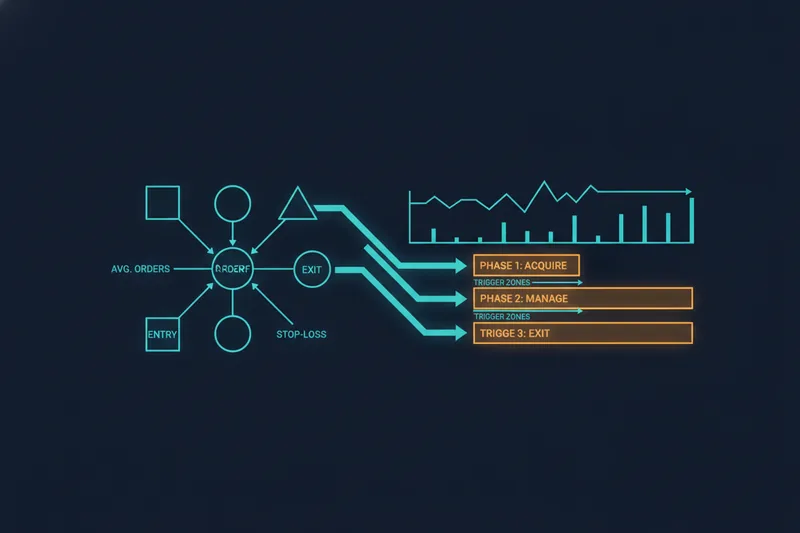
A rule-based no-code strategy builder inverts that relationship. In a deal map — a visual layout of a strategy's stages, from entry through averaging orders to exit and stop-loss — every condition is a block you placed and can edit. A condition builder lets you nest logic (price above X, and RSI below Y, and volume above Z) without code, and a visual debugger highlights the exact chart zone tied to each condition, so you can see why a trade triggered — or why it almost did, but didn't. That last distinction matters: telling the difference between "almost triggered" and "triggered" is how you catch a threshold that's producing noisy, low-quality signals before you ever risk capital on it. Copy-trading apps simply don't expose that layer — there's no chart annotation showing you the copied trader's actual decision logic, because that logic was never yours to see in the first place.
Is It Legit and Safe?
Legitimacy and safety depend heavily on which model you're using and how the provider is structured.
Copy-trading autopilot apps are generally legitimate businesses, but "legitimate" doesn't mean "risk-free." Autopilot (joinautopilot.com) and similar services typically operate through a registered investment advisor (RIA) relationship or a licensed broker-dealer partnership, which brings some regulatory oversight — but it doesn't eliminate portfolio automation risk. You're still exposed to concentration risk if the copied portfolio is heavily weighted in a few positions, timing risk if trades are replicated with a lag, and the simple fact that a politician's or influencer's disclosed trades may reflect a completely different risk tolerance, time horizon, or tax situation than yours.
Rule-based algo bots carry a different risk profile: since you built the logic, the platform itself isn't making investment decisions on your behalf, which generally means it isn't required to operate as an RIA. The risk shifts to you — a poorly tested rule set, an unrealistic backtest, or an ignored stop-loss condition can still lose money. The safety advantage is that you can test and refine before committing capital, rather than discovering a flaw only after a copied trade goes against you.
How Much Does It Cost?
Pricing models vary by category, and they're not always straightforward.
Copy-trading platforms often charge a flat subscription for account access plus, in some cases, a performance-based cut. In the crypto copy-trading space specifically, lead traders commonly collect a performance fee of 10–20% of the net profits their followers earn — a cost structure worth checking closely, since it applies on top of whatever base subscription the app charges. Brokerage-linked autopilot apps may also market themselves as commission-free, but that doesn't always mean zero cost: even commission-free brokers still pass through small regulatory charges, like the SEC fee and FINRA's trading activity fee, on stock and options sell orders regardless of the platform's own pricing.
Strategy-based platforms like Composer.trade typically charge a flat monthly subscription rather than tiered pricing based on strategies or capital. Quberas plans use a comparable no-code-builder pricing structure: access to the strategy builder, backtesting, and debugger scales with subscription tier, and the marketplace adds an option to earn recurring payouts by publishing a strategy others can subscribe to — rather than paying only to consume one.
Best Autopilot Investment Apps Compared
| App | Automation model | Transparency | Asset class | Typical cost | Control level |
|---|---|---|---|---|---|
| Autopilot (joinautopilot.com) | Copy/mirror trading via brokerage link | Low — no visible rule logic | Stocks, ETFs | Subscription, sometimes performance-based | Low — follow a pilot's portfolio |
| Composer.trade | Rule-based portfolio automation | Moderate — rules configured, less visual debugging | Stocks, ETFs | Tiered subscription | Medium |
| Quberas | No-code visual strategy builder (deal map, condition builder) | High — every condition visible and backtestable | Crypto, other markets via connected exchanges | Tiered subscription; marketplace payouts available | High — full rule authorship |
Vendor-neutral drag-and-drop builders exist across this space more broadly — platforms like Tradetron, for instance, are built entirely around letting traders assemble algorithms without writing code — which underscores that no-code isn't a Quberas-only concept, just one it applies specifically to visual deal maps and chart-level debugging.
Alternatives to Consider: Building Your Own Transparent Autopilot
If the appeal of autopilot investing is hands-off execution, but the discomfort is not knowing why a trade fired, a rule-based builder is the direct answer — you keep the automation and gain the visibility.
Build a multi-stage bot
Instead of a single buy/sell signal, a deal map lets you lay out entry conditions, averaging orders, exit rules, and stop-losses as connected stages. That structure mirrors how experienced traders actually think about a position — not one trigger, but a sequence of decisions.
Backtest before going live
Before committing capital, run the strategy against historical OHLCV (open-high-low-close-volume) data, or more granular bid/ask and order-book-derived data where available, to see how the exact rule set would have performed across different market conditions — not a hypothetical, but the same logic you'd trade live.
Debug why a trade triggered
The visual debugger highlights which chart zone caused a condition to fire, and shows near-misses alongside actual triggers. That's how you catch a threshold that's slightly too sensitive, generating false signals on noise rather than real moves — something no copy-trading dashboard will ever show you, since there's no rule to inspect in the first place.
Launch a ready-made strategy from the marketplace
If building from scratch isn't the goal, a strategy marketplace lets you select an existing rule set, set your own risk parameters, backtest it against your own history, and launch it — keeping the visibility of a rule-based system without starting from a blank canvas. Publishing your own tested strategy, in turn, can generate recurring payouts when others subscribe to it.
FAQ
Is an autopilot investment app the same as a robo-advisor? No. A robo-advisor typically builds and rebalances a diversified portfolio based on your risk profile and goals, usually as a registered advisor. An autopilot trading app either copies another trader's positions or executes a custom rule set you or someone else defined — it's not managing a diversified portfolio on your behalf by default.
Are autopilot investment apps legit? Most operate as legitimate businesses, often through a broker-dealer or RIA relationship for copy-trading products. Legitimacy doesn't equal safety, though — portfolio automation risk (concentration, lag, mismatched risk tolerance) still applies regardless of how legitimate the underlying company is.
How much does autopilot trading typically cost? Expect a subscription fee as a baseline, sometimes layered with performance fees of 10–20% on profits for copy-trading services, or tiered pricing based on strategy count or capital for rule-based builders.
Can I see the logic behind an algorithmic trading bot before it trades my money? With a no-code strategy builder that includes backtesting and a visual debugger, yes — you can inspect and test every condition beforehand. With copy-trading autopilot apps, generally no, since you're following another portfolio's live decisions rather than a fixed, inspectable rule set.
If you'd rather see every rule before it risks a dollar, try Quberas free to build a transparent, rule-based autopilot strategy you can see, test, and adjust before risking real capital.