Is Algorithmic Trading Profitable for Beginners?
Algorithmic trading can be profitable for beginners, but not for the reasons most guides suggest. The edge isn't a secret indicator or a faster server — it's visibility. Traders who can see exactly why a rule fired, test that rule honestly against historical data, and cap their downside before going live have a real shot at consistency; traders who copy a "black box" strategy and hope it works usually don't. This guide walks through the mechanics, the data, the failure modes, and a concrete workflow so you can judge your own odds rather than accept a vague "it depends."
What Is Algorithmic Trading and How Does It Work for Beginners?
Algorithmic trading means defining trading rules — conditions based on price, indicators, or volume — and letting software execute them automatically instead of a person clicking buy or sell. A rule might be "buy when the 50-period moving average crosses above the 200-period average" or "close the position if price drops 3% from entry." Once the conditions are set, the system watches the market continuously and acts the moment they're met.
How automated rules replace manual decision-making
Manual trading depends on a person noticing a setup, checking multiple factors, and pulling the trigger under pressure — which is exactly where fatigue, hesitation, and emotion creep in. Automated vs manual trading isn't about one being smarter; it's about consistency. An algorithm applies the same entry and exit conditions every time, without skipping a signal because it's 2 a.m. or second-guessing a stop-loss because the trade "feels" right. This applies across styles — scalping, range trading, trend following, gap trading, breakout trading — each of which can be encoded as rules rather than judgment calls. Not every automated tool trades on its own, either: some so-called "Expert Advisors" only enhance a chart display, while a separate one actually places orders. It's a useful reminder to check what a tool actually automates before trusting it with capital — a distinction platforms like Quberas make explicit by showing the exact logic behind every triggered condition rather than leaving it implied.
Retail traders vs institutional algo desks: what's different
Institutional desks run algorithmic trading with dedicated infrastructure, data teams, and risk officers reviewing every strategy before deployment. Retail traders don't have that backstop — but the gap has narrowed. AI-assisted and rule-based tools once reserved for hedge funds are now available directly to individual traders. The remaining difference isn't access to technology; it's discipline around validation and risk, which a beginner has to build manually.
Do You Need to Code? No-Code vs Coding Approaches
You don't need to code to trade algorithmically, but you do need to understand what each approach requires before choosing one.
What coding-based algo trading requires
Full development environments let you write custom logic in languages like Python, giving maximum flexibility but demanding real programming skill, testing discipline, and time to debug — a steep ask for someone new to markets. Automated trading tools broadly fall into four categories: full development environments, no-code/low-code builders, signal-to-execution layers, and marketplaces of pre-built bots. Beginners rarely start at the coding end for good reason.
What a no-code / visual builder changes for beginners
No-code trading platforms replace code with drag-and-drop or puzzle-style condition builders — you assemble rules from indicators, price action, and logical operators instead of syntax. Tools like Tradetron, for instance, let users build algorithms through a visual interface with no programming background required. This shortens the learning curve for beginners significantly: instead of learning a language, you're learning trading logic, which is the part that actually determines profitability.
Is Algorithmic Trading Actually Profitable? What the Data Shows
The honest answer is: it can be, but the raw win rate isn't the number that matters most. A strategy with a 40% win rate can be profitable if winners are large and losers are small; a 70% win rate strategy can still bleed capital if drawdowns are steep and uncontrolled. Evaluating a strategy properly means looking at risk-adjusted return — a Sharpe ratio above 1.0 is considered acceptable, above 2.0 very good, and above 3.0 excellent.
Retail traders often overlook the infrastructure that surrounds a strategy: execution platforms, market data feeds, and analytics or journaling tools that let you review what actually happened versus what you expected. Skipping the review step is how the same mistakes repeat. Profitability also shrinks once real costs enter the picture — even on copy-trading platforms, performance fees on profits typically run 10–20%, on top of slippage and transaction costs. Institutional desks account for these frictions by default; beginners frequently don't, which is a large part of why backtested numbers and live results diverge.
Common Reasons Beginners Lose Money with Algorithmic Trading
Why "black box" strategies fail beginners
A strategy you can't inspect is a strategy you can't fix. When a rule triggers a losing trade and you don't know which condition caused it, you're left guessing at parameter changes — adjusting a threshold blindly and hoping it helps. This hidden-trigger problem is the single biggest gap between generic "buy a bot" advice and a workable process: without visibility into why a rule fired, every adjustment is a shot in the dark, and repeated blind adjustment is how strategies get over-optimized to fit past data rather than future conditions.
Ignoring costs and slippage in backtests
Slippage — the difference between the price you expected and the price you actually got — and transaction costs quietly erode returns that look strong on paper. A backtest that ignores them will overstate performance every time, which is exactly why real fees and realistic fill assumptions need to be part of validation, not an afterthought bolted on after a strategy already looks good.
Backtesting: Why It Matters Before You Go Live
Backtesting means running your rules against historical price and volume data — often OHLCV (open, high, low, close, volume) data — to see how they would have performed before you risk real capital. It turns "I think this works" into "here's how it performed across 500 historical trades." But backtesting alone isn't the finish line: backtesting and forward testing (running the strategy live on a demo or small size going forward) are both required stages a strategy should pass before real capital is committed — neither one substitutes for the other. Strategy validation also means comparing variations — different thresholds, different stop distances — against the same historical window so you're choosing based on evidence rather than the first version that happened to look good.
Risk Management Rules Every Beginner Should Apply
No strategy, automated or manual, survives without risk controls. A few concrete rules worth applying regardless of platform:
- Position sizing: risk a small, fixed percentage of your account per trade rather than a fixed dollar amount, so losses scale down with your account, not up.
- Stop-loss on every trade: define the maximum acceptable loss before entry, not after the trade is already underwater.
- Drawdown limits: cap total risk across all open positions at once, not just per trade.
- The 3-5-7 rule: a commonly cited framework caps risk per trade at 3%, total open risk across all positions at 5%, and requires a minimum profit-to-loss ratio of 7% — the 7% refers to that ratio, not a percentage return target on the account.
Minimums matter too: some brokers allow accounts to start with as little as $100, which makes tight position sizing even more important — there's less room to absorb an oversized loss. And be wary of misquoted "rules" circulating online: Warren Buffett's well-known allocation guidance is a 90/10 split — 90% in a low-cost fund, the rest in safer assets — not the "70/30" figure sometimes attributed to him. Precision matters when a rule is guiding real capital.
How to Build a Profitable Strategy as a Beginner: A Visual Workflow
Map entries, exits, and stop-losses visually
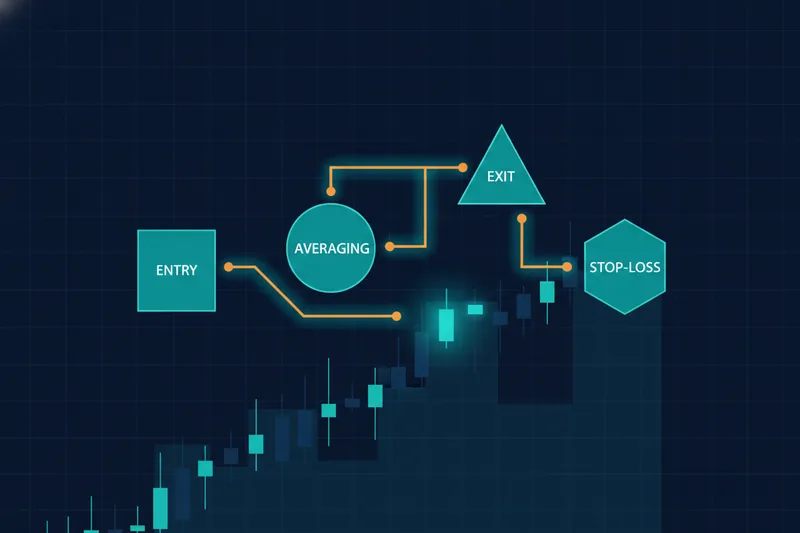
Rather than writing conditions as text or code, a deal map lays out entry conditions, averaging orders, exit rules, and stop-losses as connected visual stages. This is where Quberas' approach fits: instead of parameters buried in a settings panel, you build the sequence on the chart and see the stages connect, so it's clear what happens after entry, when averaging kicks in, and where the stop sits.
Use a visual debugger to see why a rule almost triggered vs did trigger
A visual debugger highlights the exact chart zone tied to each condition — showing not just when a rule triggered, but how close it came to triggering when it didn't. That distinction matters: a threshold that almost triggers repeatedly is generating noise, and seeing it on the chart, rather than inferring it from a log file, is what lets you fix it instead of guessing.
Tune thresholds before going live
Threshold tuning is how you reduce false signals — entries triggered by noise rather than a genuine setup. Adjust a condition, re-run the backtest, compare the result, repeat. It's worth noting that a strategy can be built and tested on a personal computer, but running it live with real money is a different reliability bar; home setups have failure modes (power, connectivity, uptime) that make more robust execution effectively necessary once you're not just testing. No-code platforms also differ in how they price this process — some charge a flat subscription regardless of how many strategies you run, others tier pricing by capital or bot count — worth checking before you commit to one for ongoing use.
Realistic Expectations: Timeframes, Returns, and Common Myths
No, you cannot reliably "make $1,000 a day" with a beginner algorithm, and no, ChatGPT cannot write you a profitable trading algorithm on request — general-purpose AI can help structure logic, but it has no access to your backtest results, your risk tolerance, or how your specific rules perform against real data. Profitability is a function of validated rules and controlled risk, not a prompt.
Timeframes also get misunderstood. Scalping strategies operate on 1- to 15-minute charts, where outcomes are shaped by execution speed and spread as much as by market direction — a very different game from a longer-term system, and not a shortcut to fast profits. Crypto specifically tends to move in multi-year cycles — historically around four years from bull peak to bear trough — not the 12–18 month cycle beginners often assume, which matters if you're judging a strategy's performance against only a few recent months. And even statistically documented edges aren't guaranteed on any given day: growth stocks outperformed value stocks roughly 64% of the time over a 30-year stretch — a real edge, but one that still lost more than a third of the time. Realistic expectations aren't pessimistic; they're what makes a strategy survivable long enough to prove itself.
Try building and backtesting your first strategy visually on Quberas — no coding required — so you can see exactly where your rules would have triggered before risking real capital.